



New Jersey businesses are adopting AI fast, and the state’s cyber-threat environment is heating up even faster. Those two curves are the whole story of this research. Blueclone Networks recently completed a structured review of the public evidence — Census adoption data, Federal Reserve regional surveys, NJCCIC incident reporting, FBI IC3 loss records, and state regulatory actions — to answer one question with data instead of opinion: is AI adoption outrunning security in New Jersey businesses?
This article is the high-level summary of that research. The full report runs seven chapters and 56 sources; here we give you the five findings that matter for business leaders, the numbers behind them, and what to do about each one. The fundamentals of AI governance are covered in our companion guide to AI governance, guardrails, and shadow AI.
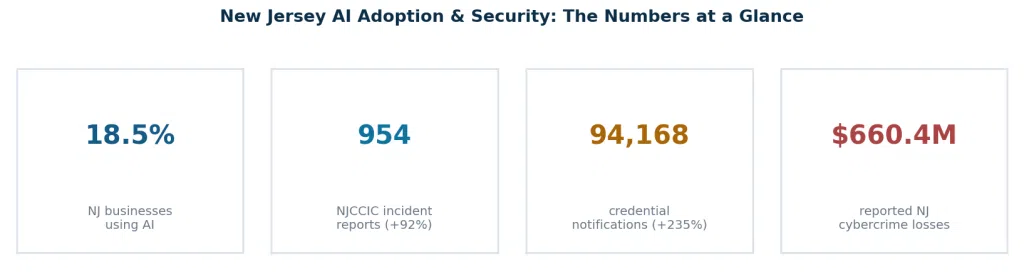
The four numbers that define New Jersey’s AI-security moment: adoption is real, and the threat environment is intensifying.
Finding 1: AI Adoption in New Jersey Is a Present-Tense Fact, Not a Forecast
As of May 2026, 18.5% of New Jersey businesses reported current AI use, with another 20.5% expecting to adopt within six months, figures nearly identical to the national rates of 19.8% and 22.8%. For business leaders, the takeaway is simple: AI governance is not a next-year problem. If your organization hasn’t defined which AI tools are approved, what data may enter them, and who owns that decision, you are already behind roughly one in five of your peers, and your employees are making those decisions themselves.
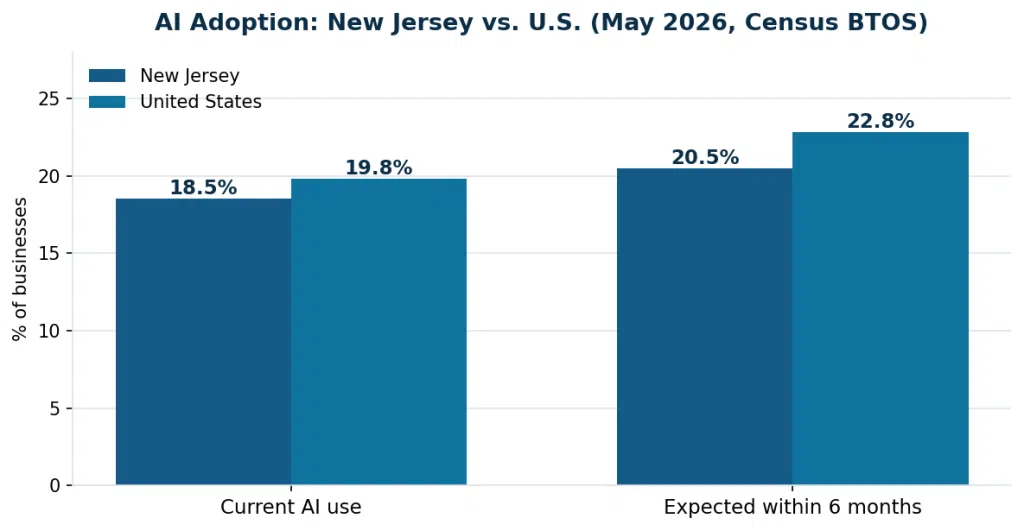
New Jersey tracks the national average on AI adoption — meaning governance is a present-tense issue, not a future one. Source: Census BTOS, May 2026.
Finding 2: Adoption Concentrates Where the Most Sensitive Data Lives
AI use rises steeply with company size from roughly 19% of businesses with 1–4 employees to 37.3% of firms with 250 or more. Nationally, knowledge-intensive sectors lead adoption: finance and insurance sit at 33.9%, well above the 19.8% overall rate. New Jersey’s economy is concentrated in exactly these sectors: financial services, pharmaceuticals, life sciences, and professional services, so the state’s adoption pressure is structural. The businesses adopting AI fastest are the ones holding client funds, patient records, and regulated data.
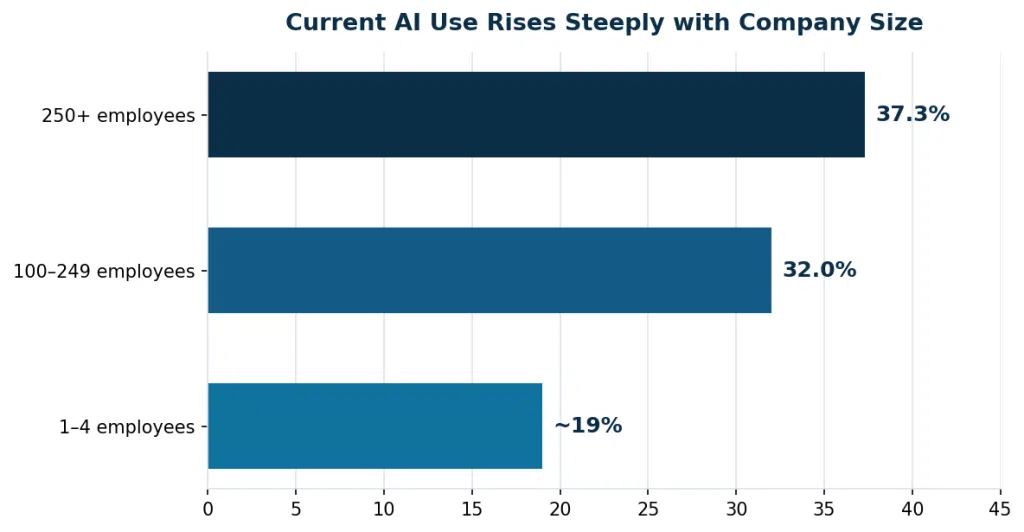
Current AI use by company size. Larger firms adopt more, and carry larger identity estates, vendor networks, and data flows to govern.
Regionally, the signal is even sharper. In the New York–Northern New Jersey Federal Reserve survey region, 61% of service firms and 51% of manufacturers reported using AI in business processes in 2026, up from 25% and 16% respectively in 2024. One honest caveat: median worker penetration within adopting firms is only 17% in services and 7% in manufacturing, and most firms describe their AI investment as minimal or modest. Broad adoption, shallow depth, which is precisely the stage where governance is cheapest to build and easiest to skip.
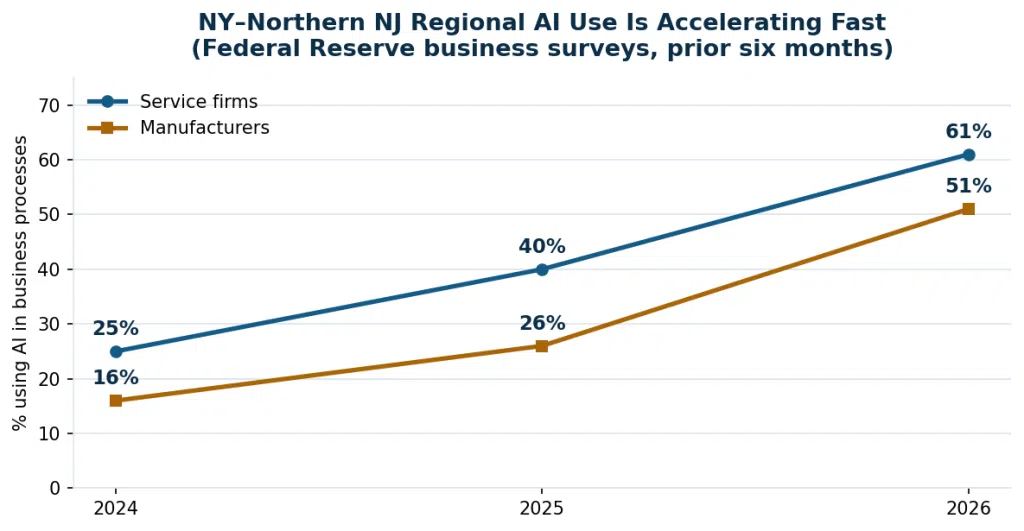
The NY–Northern NJ regional acceleration curve. These are regional figures, not statewide NJ rates, but the direction is unmistakable.
Finding 3: The Threat Environment Is Worsening on Every Measured Axis
While adoption accelerates, New Jersey’s security pressure signals are steepening:
- 954 cybersecurity incident reports to NJCCIC in 2025 — up 92% year over year, with social engineering the largest category.
- 94,168 compromised-credential notifications — up 235% in a single year, and up from just 16,175 in 2022.
- 1,951 breach reports affecting New Jersey residents in 2025, dominated by ransomware and unauthorized access.
- $660.4 million in reported cybercrime losses — the fifth-highest state total in the country, per the FBI’s IC3.
The credential curve deserves special attention. Identity matters twice in an AI era: employees authenticate to AI applications with credentials, and AI integrations introduce non-human identities, API keys, and service accounts that most organizations don’t monitor. A binary “MFA enabled” checkbox is no longer sufficient, complete eligible-account coverage and privileged-account discipline are what actually reduce risk.
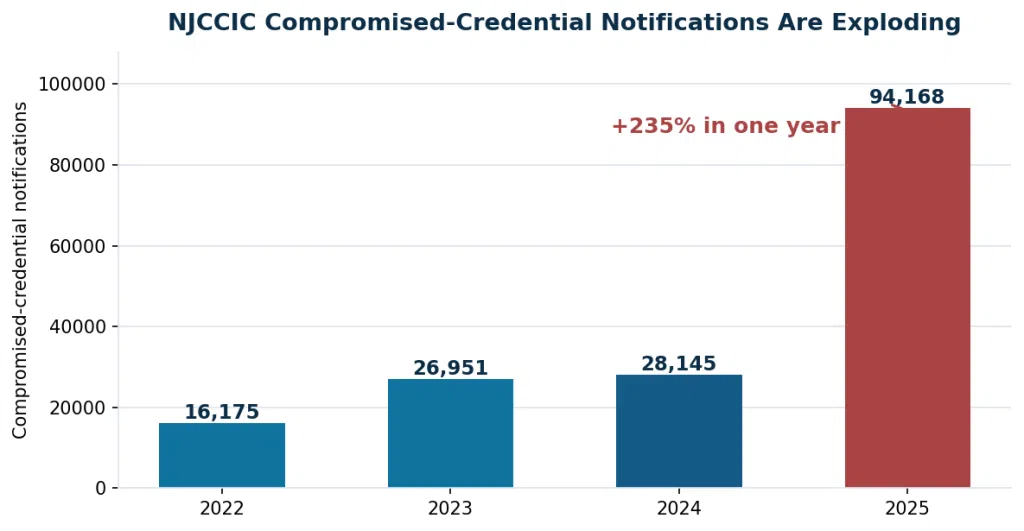
NJCCIC compromised-credential notifications, 2022–2025. The steepest curve in the entire dataset, and the control most directly tied to AI-era risk.
Finding 4: Regulators Have Already Merged AI and Security Into One Topic
In June 2026, the New Jersey Bureau of Securities announced that its annual examination of nearly 800 state-registered investment adviser firms would focus jointly on protecting sensitive data and emerging AI risks: asking about AI use, written policies, employee training, and third-party vendor due diligence in the same supervisory process. New Jersey’s privacy law independently makes data governance measurable: data minimization, reasonable safeguards, sensitive-data handling, and control of data paths all translate directly into AI governance requirements.
The enforcement record reinforces the point. The Enzo Biochem settlement, arising from a breach affecting 2.4 million patients, roughly 331,600 of them New Jersey residents, produced a $4.5 million multistate settlement and a remediation list that begins with a decades-old basic: MFA required for all user accounts. The lesson generalizes: if identity fundamentals can fail in sensitive-data environments without AI, adding AI without them compounds the exposure. Every AI tool also brings vendors, connectors, and data flows, making vendor review a frontline security control rather than procurement paperwork.
Finding 5: The Honest Answer, and the Benchmark That Doesn’t Exist Yet
Here is the finding that separates this research from the marketing you’ll read elsewhere: no public dataset measures AI adoption and security-control maturity in the same New Jersey businesses. The evidence supports a serious, measurable question and a rising exposure surface. It does not support a fabricated statewide “AI security gap percentage”, and any statistic like that you encounter is invented.
The research therefore proposes a matched benchmark: measuring AI use and control maturity in the same organizations against observable pass rules (approved AI tools, complete MFA coverage, controlled data paths and DLP, vendor review, patch and endpoint maturity, monitoring, and tested backup and recovery) aligned with the NIST AI Risk Management Framework and the NIST Cybersecurity Framework. Until that benchmark exists, the right move for your business is to measure itself against those same pass rules.
What Business Leaders Should Do Now
- Approve an AI tool list and acceptable-use policy — so adoption happens inside guardrails instead of around them.
- Discover your shadow AI — find the unsanctioned tools and connectors employees are already using before they become incident reports.
- Harden identity completely — MFA across all eligible accounts, privileged-access discipline, and monitoring of the non-human identities AI integrations create.
- Control data paths — define what data may enter AI workflows, block what may not, and trace where it goes.
- Review AI vendors — the same access, terms, and retention questions New Jersey regulators are asking investment advisers.
- Stand on a monitored foundation — patching, backup, recovery, and 24/7 detection through managed IT services and cybersecurity services.
That list is exactly what Blueclone Networks delivers for New Jersey businesses: AI strategy and governance, shadow-AI discovery, identity hardening, data-path control, vendor review, compliance readiness, and the managed security foundation underneath, through a team-based model that costs less than a single senior hire. Contact Blueclone to start with an AI posture and data-readiness assessment.
Frequently Asked Questions
The best public statewide benchmark is 18.5% of New Jersey businesses reporting current AI use as of May 2026, with another 20.5% expecting to adopt within six months, close to the U.S. rates of 19.8% and 22.8%. Regionally, the signal is stronger still: 61% of service firms in the New York–Northern New Jersey Federal Reserve survey region reported AI use in 2026. These are business-level measures, not worker-level ones.
No, and it’s important to be honest about that. The research finds material AI adoption and substantial, worsening cyber pressure, but no public statewide dataset measures AI adoption and security-control maturity in the same businesses. The responsible conclusion is that the question is serious and measurable but not yet proven statewide. Any specific ‘AI security gap percentage’ for New Jersey seen in marketing is fabricated, because the matched data does not exist yet.
NJCCIC issued 94,168 compromised-credential notifications to New Jersey organizations in 2025, up 235% from 2024. A notification is not the same as a unique business being hacked — one organization can receive multiple. The figure is an identity-risk signal, and a steeply worsening one. For AI governance it matters twice: employees authenticate to AI applications with credentials, and AI integrations add non-human identities, API keys, and service accounts that expand the identity estate.
In June 2026, the New Jersey Bureau of Securities announced that its examination of nearly 800 registered investment adviser firms would focus jointly on AI use and cybersecurity including written policies, employee training, and third-party vendor due diligence. New Jersey’s privacy law independently requires data minimization, reasonable safeguards, and sensitive-data handling that translate directly into AI governance. The direction is clear: regulators treat AI use and security as one supervisory topic.
Start with an AI posture and data-readiness assessment measured against observable pass rules: an approved AI tool list and acceptable-use policy, complete MFA coverage across all eligible accounts, controlled data paths with DLP, vendor review for AI tools and connectors, patch and endpoint maturity, security monitoring, and tested backup and recovery. These controls align with the NIST AI Risk Management Framework and the NIST Cybersecurity Framework, and they are exactly what New Jersey regulators are beginning to examine.


