


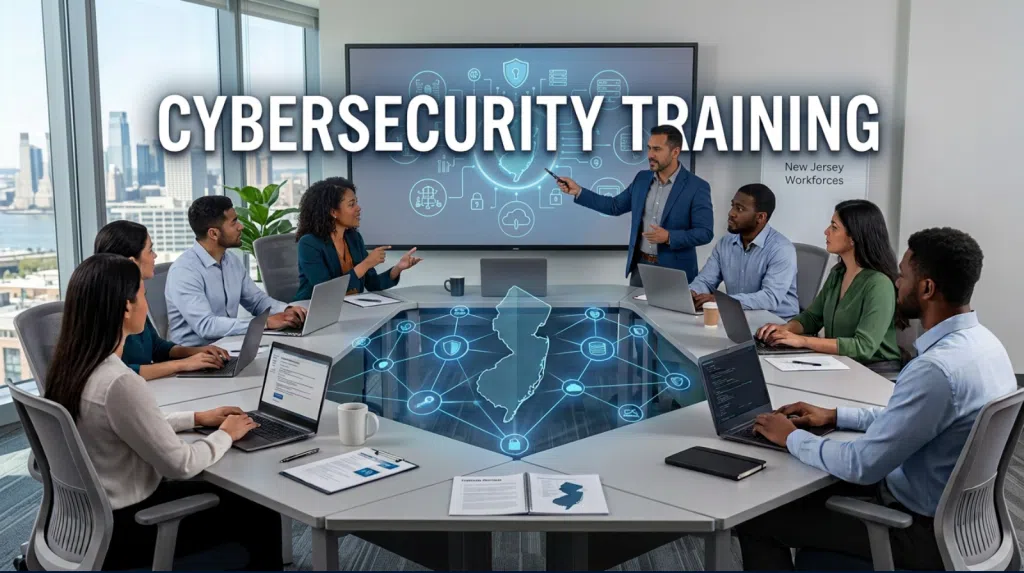
New Jersey businesses operate in one of the most targeted cyber environments in the country. The FBI’s Internet Crime Complaint Center recorded $660.4 million in reported cybercrime losses from New Jersey in a single year, the fifth-highest state total in the nation. The state’s cybersecurity agency also logged a 92% year-over-year increase in incident reports. Behind most of those numbers is the same root cause: a person unprepared for the moment an attacker reached them.
Employee cybersecurity training has become one of the highest-return security investments a New Jersey business can make. The Verizon Data Breach Investigations Report consistently finds that the human element, including phishing, stolen credentials, misuse, and error, is involved in the majority of breaches. No firewall, endpoint tool, or cloud platform can compensate for a workforce that doesn’t recognize the attack aimed at it.
Blueclone Networks helps New Jersey businesses build cybersecurity training programs focused on changing employee behavior rather than simply checking a compliance box. In this guide, we cover why training matters more than ever for New Jersey businesses, what an effective program includes, how to implement it step by step, and how to measure whether it’s actually working.
Why New Jersey Workfaces Need Cybersecurity Training More Than Ever
New Jersey Is a High-Value Target
New Jersey’s economy concentrates exactly the industries attackers prize: financial services, pharmaceuticals, healthcare, logistics, and professional services. The state files fewer cybercrime complaints per capita than most states but ranks near the top in losses per capita, a pattern consistent with high-value targets being hit hard. When your workforce handles client funds, patient records, intellectual property, or regulated financial data, every employee is a potential entry point worth six or seven figures to an attacker.
The Threat Environment Is Worsening Fast
The New Jersey Cybersecurity and Communications Integration Cell (NJCCIC) received 954 cybersecurity incident reports in 2025, up 92% from 2024, and issued 94,168 compromised-credential notifications, a 235% increase in a single year. Social engineering was the largest reported incident category. The attacks reaching your employees are increasing in both volume and sophistication, and AI-generated phishing has made once-obvious scams nearly indistinguishable from legitimate communications.
Regulators and Insurers Require It
Employee cybersecurity training is no longer optional for many New Jersey businesses. The New Jersey Bureau of Securities’ examination of nearly 800 registered investment adviser firms explicitly asks about periodic employee training alongside AI use and vendor due diligence. HIPAA requires workforce security awareness training for healthcare organizations. PCI DSS mandates a formal security awareness program for anyone handling cardholder data. And cyber insurance underwriters now routinely require documented training before issuing or renewing coverage as we covered in our guide to budgeting for IT and cybersecurity in New Jersey.
Hybrid Work Expanded the Human Attack Surface
New Jersey’s proximity to New York City makes it one of the most hybrid-work-intensive markets in the country. Every home network, personal device, and remote session extends your security boundary into environments you don’t control. Training is the one control that travels with the employee, whether they’re working from Princeton, Hoboken, or a coworking space.
What Effective Employee Cybersecurity Training Includes
Phishing and Social Engineering Recognition
Phishing remains the number one initial access vector because it works. Effective training teaches employees to recognize the modern tells: urgency and pressure, unusual payment or wire requests, lookalike domains, unexpected attachments, and requests to bypass normal procedures. Crucially, it also teaches verification behavior, confirming unusual requests through a second channel before acting, which stops business email compromise even when the email itself looks perfect.
Password Hygiene and Multi-Factor Authentication
With 94,168 compromised-credential notifications issued to New Jersey organizations in a single year, credential discipline is a frontline defense. Training should cover using a password manager, never reusing passwords, recognizing MFA fatigue attacks (repeated push notifications designed to wear users down into approving), and never sharing codes with anyone including “IT.”
Safe Data Handling
Employees need clear rules for the data they touch every day: what may be shared externally, what must stay in approved systems, why forwarding work files to personal email or personal cloud storage creates breach exposure, and how to handle sensitive client, patient, or financial information. This is especially critical in New Jersey’s regulated industries, where a single mishandled record can trigger notification obligations under state law.
Device and Remote Work Security
Workforce training must address the realities of hybrid work: recognizing rogue Wi-Fi networks, keeping personal devices used for work updated, the risks of public charging stations, and why lost or stolen devices must be reported immediately rather than quietly replaced. Every unreported lost device is an unmanaged breach risk.
AI Tool Usage and Shadow AI
The newest training frontier is AI. Employees are adopting AI tools faster than most organizations are governing them, and as we documented in our research on AI adoption and security in New Jersey businesses, 18.5% of the state’s businesses already use AI with another 20.5% expecting to adopt within months. Training must cover what data may and may not be entered into AI tools, which tools are approved, and how to report a new AI tool need instead of quietly adopting one, because shadow AI is now one of the fastest-growing ungoverned risks in the workplace.
Incident Reporting
The most important skill training can build is the willingness to report. Employees must know exactly how to report a suspicious email, a clicked link, a lost device, or an odd system behavior, and must trust that reporting is met with thanks, not blame. A workforce that reports in minutes instead of hiding mistakes for days is the difference between a contained incident and a full breach.
How to Implement Employee Cybersecurity Training: A Step-by-Step Approach
Step 1: Establish a Baseline
Before launching training, measure where your workforce stands. Run a baseline phishing simulation to see current click and report rates, survey employee security knowledge and attitudes, and review past incidents for human-factor patterns. The baseline does double duty: it prioritizes your program and gives you the before-and-after evidence that proves the program works.
Step 2: Secure Leadership Participation First
Nothing kills a training program faster than executives who exempt themselves. Require leadership to complete training before everyone else and to speak about it visibly. When the CFO reports a phishing email in front of the team, the cultural message is worth more than a dozen memos. As we covered in our guide to building a security-first culture, visible leadership commitment is the single strongest predictor of training success.
Step 3: Deploy Continuous, Role-Relevant Content
Replace the annual compliance video with a continuous cadence: short monthly micro-training modules, quarterly phishing simulations with immediate feedback, and role-specific deep dives. Finance staff need business email compromise and payment-fraud scenarios; healthcare workers need HIPAA and patient-data handling; developers need secure coding; leadership needs deepfake and executive-impersonation awareness. Relevance is what makes training stick.
Step 4: Make Reporting Frictionless
Deploy a one-click report button in your email client, publish a clear escalation path for all incident types, and publicly thank reporters, even for false alarms. Then track reporting rate as a positive metric: rising reports mean rising vigilance. Organizations that punish honest mistakes teach silence, and silence is precisely what attackers depend on.
Step 5: Onboard Every New Hire From Day One
Security training should be part of onboarding, not a six-month-later afterthought. Every new employee should complete baseline security training, learn the reporting process, and understand the acceptable-use rules, including AI tool policies, before they receive access to sensitive systems. First impressions set behavior.
Step 6: Measure, Report, and Iterate
Review your metrics quarterly: phishing click rate (should trend down), reporting rate (should trend up), training completion, time-to-report, and incident trends. Report results to leadership in business terms, adjust content based on what the data shows, and refresh scenarios as attackers adopt new techniques. Training that isn’t measured is theater.
Common Training Mistakes New Jersey Businesses Make
- Treating training as an annual checkbox. Knowledge decays within months; annual-only training leaves employees exposed most of the year.
- One-size-fits-all content. Generic videos ignore the specific threats each role faces. Role-relevant scenarios are what change behavior.
- Punishing simulation failures. Publicly shaming employees who click simulated phishing teaches them to hide real clicks. Use teachable feedback instead.
- Ignoring AI usage. Most programs still don’t address what data employees may enter into AI tools, one of today’s fastest-growing risks.
- Excluding executives. Leadership is the most-targeted group (executive impersonation, wire fraud) and the most-watched. Their participation is non-negotiable.
- Measuring completion instead of behavior. A 100% completion rate says nothing about whether anyone can recognize a phishing email. Track click rates and reporting rates instead.
Building a Stronger Cybersecurity-Aware Workforce with Blueclone Networks
Blueclone Networks helps New Jersey businesses strengthen employee cybersecurity awareness through ongoing training programs designed to reinforce secure habits throughout the year. Our approach includes:
- Continuous awareness training: Monthly micro-modules and role-specific content that keeps security top of mind year-round.
- Phishing simulation campaigns: Realistic, AI-era scenarios with immediate teachable feedback and trend reporting quarter over quarter.
- One-click reporting tools: Email reporting buttons and clear escalation paths that make reporting the easiest behavior in your organization.
- AI usage and shadow-AI training: Policies and education covering approved AI tools, permitted data, and how to request new tools instead of adopting them silently.
- Compliance-aligned curricula: Training mapped to HIPAA, PCI DSS, CIRCIA, and New Jersey regulatory examination expectations, with completion evidence for auditors and insurers.
- New-hire onboarding security training: Day-one baseline training so every employee starts with the right habits.
- Leadership and executive briefings: Targeted training for your most-impersonated and most-targeted people, plus board-ready risk reporting.
- The technical foundation underneath: Managed IT services and cybersecurity services that provide MFA, monitoring, and rapid response, ensuring a trained workforce is supported by a hardened IT environment.
A comprehensive cybersecurity training program shouldn’t require the cost of hiring a dedicated senior security professional. Blueclone Networks provides New Jersey businesses with the expertise, ongoing guidance, and technical support needed to strengthen employee security awareness. Contact Blueclone Networks to assess your current training baseline and develop a program that fits how your team actually works.
Frequently Asked Questions
New Jersey combines high-value regulated industries with one of the most active threat environments in the country: $660.4 million in reported cybercrime losses in a single year (fifth-highest state total), a 92% year-over-year increase in incident reports, and 94,168 compromised-credential notifications. The state’s concentration of financial services, healthcare, pharma, and professional services makes every employee a high-value target. Training is the control that determines whether the attacks reaching your workforce succeed or fail.
Effective programs are continuous rather than annual: short monthly micro-training modules, quarterly phishing simulations with immediate feedback, role-specific refreshers as threats evolve, and security onboarding for every new hire on day one. Research consistently shows that knowledge from annual-only training decays within months, leaving employees exposed most of the year. The cadence matters more than the total hours — frequent, brief reinforcement changes behavior; long, rare sessions do not.
A phishing simulation is a safe, controlled test email that mimics real attacks, sent to your own employees to measure whether they click, report, or ignore it. When paired with immediate teachable feedback, not punishment, simulations measurably reduce click rates over time and increase reporting rates. They work best as a regular quarterly practice with realistic, role-relevant scenarios, including modern AI-generated phishing, business email compromise, and executive impersonation attempts.
For many businesses, yes. HIPAA requires workforce security awareness training for healthcare organizations, PCI DSS mandates a formal security awareness program for anyone handling cardholder data, and the New Jersey Bureau of Securities’ examination of nearly 800 registered investment adviser firms explicitly asks about periodic employee training. Cyber insurance underwriters also routinely require documented training before issuing or renewing coverage. Even where not formally mandated, training evidence is increasingly examined during audits and after incidents.
Track behavior, not completion. The key metrics are phishing simulation click rate (should trend down over quarters), reporting rate (should trend up — rising reports indicate vigilance, not danger), time-to-report for simulated and real incidents, training completion and timeliness, and the human-factor pattern in any real incidents. Review metrics quarterly, report them to leadership in business terms, and adjust content based on what the data shows. A program that only measures completion percentages is measuring the wrong thing.


