






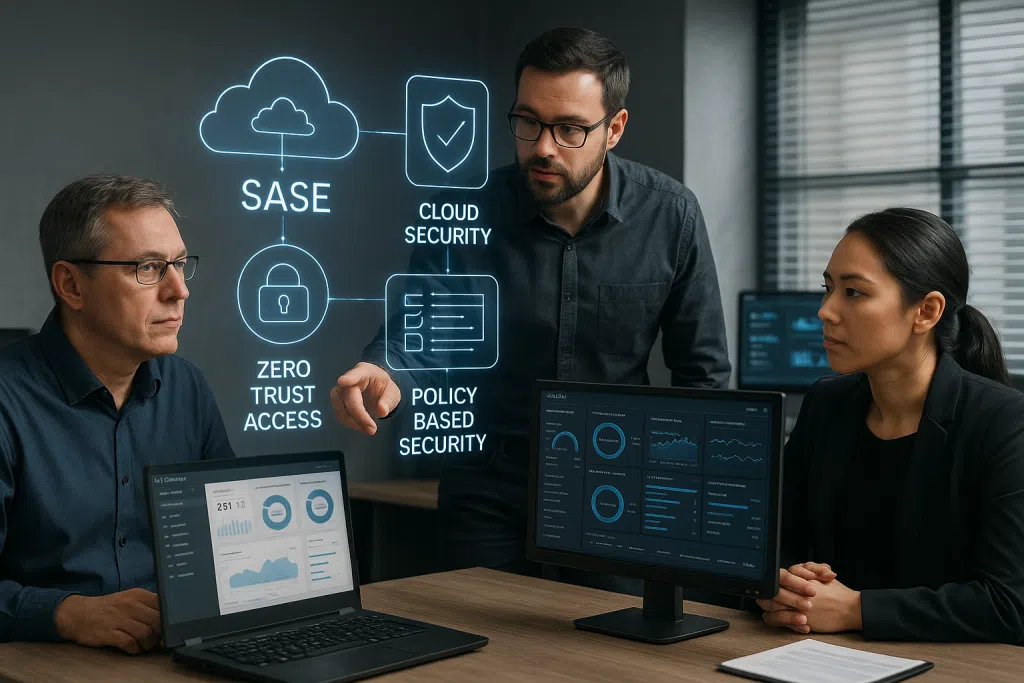
Understanding the SASE Security Framework: What Sets It Apart?
Small and midsized businesses in fields like healthcare, finance, and law face rising expectations to manage data security and compliance, often without the large budgets of enterprise organizations. In this climate, the Secure Access Service Edge (SASE) security framework has changed how organizations defend their data, regulate user access, and enable secure remote work.
SASE security framework is not just another industry buzzword; it merges networking and security functions into a cohesive, cloud-native architecture. Instead of running separate appliances or cobbling together standalone tools, SASE makes it possible to deliver secure access wherever users, devices, applications, and data live, no matter if your team is at headquarters, working from branch offices, or tapping in from remote locations. This distinction is especially important for SMBs in regulated sectors, where HIPAA, FINRA, HITECH, and other compliance requirements can make or break your ability to operate.
At its core, SASE security brings together wide-area networking (WAN) with security services such as secure web gateways, firewalls, zero trust access controls, data loss prevention, and cloud access security brokers (CASB). These functions are provided through the cloud, making them accessible to all users regardless of where they connect. Think of SASE as a framework that helps organizations consolidate security tools, reduce manual overhead, and streamline compliance, all while scaling to support growth.
Deployments of older network architectures often struggle to provide consistent protection and easy access across distributed teams. SASE turns that model inside out. Rather than relying on a patchwork of point solutions, it centralizes security policy management, decouples access from physical location, and reduces complexity. This approach aligns with the mobile, cloud-powered reality faced by healthcare clinics racing to implement telemedicine, legal firms sharing sensitive files, and financial advisors managing hybrid remote offices.
Understanding the layers and nuances of SASE meaning is vital for regulated SMBs whose top priorities include patient privacy, secure financial transactions, and airtight legal document management. By adopting a SASE security model, organizations can not only meet compliance obligations but also adapt faster to the growing sophistication of cyber threats.
For regulated organizations in New Jersey, Eastern Pennsylvania, and the NYC Metro Area, blueclone.com helps guide the adoption of best SASE solutions tailored to your specific compliance and operational needs. Whether you have a dedicated IT team or rely on co-managed IT partnerships, getting started with a discovery meeting is the fastest way to assess your current security posture and chart a path toward seamless network security transformation. Book an initial Discovery meeting here.
Secure Access Service Edge: Concepts, Components, and Real-World Use
To grasp what makes SASE a pivotal development in modern network security, organizations should first understand its core components. Secure Access Service Edge isn’t a single product, but rather a model that unifies four principles: identity-driven access, cloud-native architecture, real-time context awareness, and dynamic scalability. SASE meaning pivots away from the idea of a traditional, hardware-centric security perimeter.
A SASE network security solution typically includes a set of integrated technologies:
Software-Defined Wide Area Network (SD-WAN):
Provides efficient, reliable connections between branch offices, cloud services, and data centers. SD-WAN routes traffic based on real-time conditions, improving application performance and reducing reliance on expensive, static MPLS circuits.
Security Service Functions Delivered Through the Cloud:
- Secure Web Gateway (SWG): Blocks access to malicious or non-compliant websites and content.
- Cloud Access Security Broker (CASB): Monitors and controls access to cloud services, enforcing compliance and protecting sensitive data.
- Firewall-as-a-Service (FWaaS): Replaces traditional firewalls with a cloud-based alternative, streamlining management and coverage.
- Zero Trust Network Access (ZTNA): Limits access to resources based on verified user identity, device compliance, and contextual factors.
- Data Loss Prevention (DLP): Prevents sensitive information from leaving the organization via email, uploads, or illicit file transfers.
Centralized Policy Management:
With SASE, policy enforcement is consistent regardless of user location. IT teams can manage rule sets through a single interface, cutting down on duplicated effort and human error.
Continuous Security Inspection:
Traffic, regardless of source or destination, is inspected in real time. This level of oversight is especially valuable when employees move between offices, home networks, and public connections.
Take, for example, a medical practice in Princeton providing both on-site consultations and telehealth appointments. With SASE security, a doctor connecting from home enjoys the same level of secure access as one working inside the hospital, without requiring complex VPNs or exposing the network to unnecessary risk. A law firm with remote attorneys collaborating on sensitive cases can restrict file access based on job role and ensure all communication is encrypted, crucial for maintaining client confidentiality and regulatory compliance.
According to Gartner’s 2025 research, early adopters in healthcare and finance report reduced security incidents and simpler compliance reporting thanks to unified, cloud-managed policies. This is echoed in Blueclone’s casework for regional clients, who have experienced streamlined network administration and faster responses to cyber threats after SASE adoption. The flexibility of SASE allows local SMBs to pursue remote work, multi-cloud strategies, and digital transformation without opening security gaps.
A second example: Consider an accounting firm that relied on legacy infrastructure. Frequent remote logins led to gaps in coverage, inconsistent application of security policies, and difficulty passing annual SOC or HIPAA audits. Once SASE network security was deployed, all traffic was routed through secure cloud gateways, role-based permissions could be managed dynamically, and detailed activity logs aided both compliance and rapid incident response.
In regulated sectors, the choice to embrace the SASE security framework isn’t just about keeping up with technology trends. It’s a strategic move to reduce risk and complexity in an era of expanding cybersecurity requirements.
If your IT or compliance team needs help planning this transition, Blueclone Networks provides tailored SASE solutions for businesses in healthcare, finance, and legal sectors across Central NJ and the NYC metro area. Book an initial Discovery meeting here to discuss how SASE can secure your operations.
SASE Security in Healthcare, Finance, and Legal: Addressing Industry-Specific Challenges
Rising threats and strict regulations in healthcare, finance, and law put enormous pressure on SMBs to safeguard data without overwhelming their teams or budgets. SASE security targets these unique challenges, helping businesses achieve robust compliance and defense while embracing innovation like AI and cloud computing.
Healthcare:
Practices handling protected health information (PHI) contend with HIPAA, HITECH, and OCR-mandated safeguards. SASE supports these mandates by encrypting data end-to-end, segmenting user access based on roles such as physician, nurse, or admin, and offering centralized controls so no device punches above its authorization level. The result is reduced exposure to breaches and violations, which is critical as telemedicine becomes standard and e-prescribing increases reliance on cloud platforms.
A 2025 study by Healthcare IT News found that healthcare SMBs deploying the best SASE solutions cut their reported breach rates by nearly 40 percent over two years, simply by closing gaps that perimeter-based firewalls missed. Cloud-based inspection also improved the speed of incident detection, crucial for meeting HIPAA breach notification deadlines.
Finance:
Financial firms face a dual challenge: defending against sophisticated cyber threats while also demonstrating rigorous controls to regulators (SEC, FINRA) and insurers. SASE enables segmenting access down to precise business units or client groups, logging every login attempt, file access, and transaction in tamper-resistant logs aligned with audit criteria. Secure access service edge technology excels at protecting both legacy transactional systems and new SaaS apps used by investment advisors and accountants.
For SMBs in the financial sector, deploying SASE means they can onboard remote advisors securely, grant clients controlled portal access, and implement document-sharing workflows with granular permissions. Most importantly, SASE helps meet security requirements for cyber-liability insurance by killing off shadow IT and providing clear evidence of continuous monitoring.
Legal:
Law firms are custodians of sensitive contracts, case files, and communications. Client confidentiality is paramount, and state bar associations are sharpening requirements around encrypted storage, secure file transfer, and access controls. With SASE, even small practices can deliver big-firm security by restricting access to case files by attorney or paralegal, monitoring file movements, and deploying behavioral analytics to identify attempts at data exfiltration.
Law firms in Princeton and Trenton have begun using SASE to implement frictionless client collaboration while reducing the risk of data exposure from lost or stolen laptops. Centralized threat intelligence and single-pane-of-glass policy management make compliance with ABA and state cyber guidelines much more attainable for small practices operating without full-time IT staff.
SASE network security is especially relevant as legal and healthcare SMBs embrace AI-powered solutions for document processing or automated marketing. By controlling how AI tools integrate and what data they touch, SASE helps ensure new technologies don’t introduce unknown vulnerabilities.
Comparing Traditional Perimeter Security and SASE Network Security in SMB Environments
To appreciate why the SASE security framework has become popular among regulated SMBs, it helps to compare it concretely to conventional security methods.
Traditional Perimeter Security
Historically, organizations deployed heavyweight firewalls, VPNs, and intrusion detection systems at the edge of a physical office. Daily operations relied on everyone coming to work onsite. When remote work or cloud apps entered the scene, IT teams faced mounting difficulties:
- Every remote connection or third-party access requires separate VPNs, more firewall rules, and extra authentication setups.
- Policy management was fragmented, sometimes requiring manual repetition across dozens of branch offices.
- Security gaps increased as cyber attackers targeted remote workers, unmanaged endpoints, and unpatched gateway systems.
This complexity often led to “security drift,” where rules weren’t updated fast enough or were inconsistently enforced. Auditing configurations became much harder, and each new SaaS tool forced more exceptions and workarounds.
SASE Security Framework
By contrast, SASE network security assumes company resources, data, and users are spread everywhere, not just inside an office network. It recognizes the modern blend of on-premises, cloud, and mobile work, and frames security as a cloud-delivered, always-on utility:
- Unified policies apply no matter where users sign in or what device they use.
- Security is “built-in at the edge”, following users, rather than anchoring to a location.
- Every connection, whether to an electronic medical record, legal document repository, or financial SaaS app, passes through cloud-based inspection engines applying consistent rules.
As reported by Cybersecurity Magazine in early 2025, organizations that shifted to SASE reported a 60 percent drop in administrative overhead compared to legacy architectures, freeing IT teams to focus on business strategy instead of troubleshooting individual security appliances.
Tangible Benefits for SMBs
- Lower Costs: Moving from physical to cloud-based security removes the need for many hardware purchases and complex maintenance cycles.
- Easier Compliance: Centralized auditing, logging, and reporting simplify preparation for regulatory inspections, whether it’s a HIPAA audit or a FINRA review.
- Greater Flexibility: Teams can add, move, or scale locations without wrestling with complex network redesigns.
- Better User Experience: Staff experience consistent, secure access whether at a desk, in court, at a client site, or working from home.
Healthcare practices, law firms, and financial agencies in New Jersey are already drawing value from this approach. For example, small clinics have quickly enabled secure telehealth platforms during COVID-19, while accounting firms have expanded seasonal staffers without creating new attack vectors. If your organization is ready to modernize, consider how best SASE solutions could drive simplicity and trust for your IT environment.
Criteria for Evaluating the Best SASE Solutions for SMBs
With growing interest in SASE security, the market is flush with vendors promising cloud-delivered protection. For IT and compliance leaders, making informed decisions requires more than just comparing feature lists. The right SASE security solution should support your operational and regulatory needs, without overburdening your staff or budgets.
When evaluating SASE options, prioritize these criteria:
1. Regulatory Compatibility
Does the solution align with relevant frameworks, HIPAA for healthcare, PCI-DSS for finance, and ABA recommendations for legal? Best SASE solutions will have certified compliance tools, automated reporting features, and documented evidence of passed third-party audits.
2. Policy Granularity
Look for solutions offering detailed, role-based access controls and contextual policies that can distinguish between employee types, devices, and geographic locations. This is especially important with co-managed IT environments where on-site and remote resources need differing permissions.
3. User Experience
A good SASE security deployment shouldn’t disrupt legitimate business activity. Evaluate ease of onboarding, transparent authentication mechanisms (such as single sign-on), and minimal friction for end-users accessing cloud platforms, remote desktops, or telemedicine portals.
4. Analytics and Incident Response
Continuous monitoring with actionable analytics helps organizations not only spot threats faster but also prove compliance. Some SASE frameworks integrate with security information and event management (SIEM) platforms. Consider how easily you can retrieve logs or generate reports needed for your sector.
5. Flexible Integration
As many SMBs in regulated sectors embrace AI-powered tools, VoIP, or cloud-based legal/case management software, your SASE platform must easily hook into new workflows. Avoid products that require heavy customization or rigid contracts just to add cloud or AI integrations.
Recent industry reviews, such as those published by TechTarget in March 2025, emphasize the importance for SMBs to pilot potential solutions in real-world workflows before full rollout. Choosing a local IT partner familiar with both SASE network security and your regulatory landscape accelerates implementation and reduces risk.
Mid-way through your evaluation, it can be valuable to consult with experts who know the regional market and can tailor their recommendations. Book an initial Discovery meeting with Blueclone Networks here to discuss options that fit your compliance requirements and operational goals.
SASE Security Framework: Key Takeaways and Next Steps for Regulated SMBs
SASE security continues to evolve, but its advantages for regulated SMBs are already clear, consolidated policy enforcement, consistent user experiences, easier compliance, and strong defense even as teams and data become more distributed. For healthcare, finance, legal, and pharmaceutical businesses across Central New Jersey, Eastern Pennsylvania, and the NYC Metro area, SASE offers a path to future-proofing digital operations.
Key takeaways for SMB decision-makers and IT leaders:
- Unification Is Power: SASE merges multiple security and networking tools, ending the siloed management that plagued earlier architectures.
- Compliance Is Simplified: Automated documentation and real-time, encrypted access make HIPAA, FINRA, or ABA readiness more achievable.
- Remote Work Is Natively Supported: As hybrid and flexible work become permanent, SASE security ensures your staff stays protected without impeding efficiency.
- Smarter Adoption of AI and Cloud: SASE’s architecture supports secure integration with next-generation technologies, helping small firms keep pace without sacrificing safety.
What’s next for your business? Mapping out a SASE migration may start with a candid assessment: How is your network traffic secured today? Where are compliance gaps, and what future business changes will require more flexible scaling? Collaborative planning with an experienced IT partner, such as Blueclone Networks, helps ensure your SASE deployment meets real-world challenges specific to your region and sector.
Taking the next step is straightforward: Schedule a tailored Discovery meeting to review your security posture, compliance requirements, and strategic goals. Book an initial Discovery meeting here and start building a more secure, agile future for your organization.
Frequently Asked Questions (FAQ) about the SASE Security Framework
SASE stands for Secure Access Service Edge. Unlike traditional perimeter security that relies on single-location firewalls and VPNs, SASE integrates networking and security functions into a cloud-native architecture. This approach defines and enforces security policies based on user identity, device status, and location, allowing consistent, reliable protection across all environments, on-site, remote, and cloud-based.
Yes. One of the biggest advantages of the SASE security framework is its ability to centralize compliance controls, automate reporting, and maintain audit trails. Whether it’s encrypting health data, logging financial transactions, or restricting legal file access, SASE architectures help regulated businesses satisfy their sector’s unique regulatory standards.
SASE is especially beneficial for SMBs and growing regional firms. By leveraging cloud-delivered tools, small and mid-sized organizations gain access to enterprise-grade network security without the need for heavy hardware investments or large IT teams. SASE’s scalability makes it ideal for businesses that need to pivot quickly, add locations, or support remote work.
Implementation timelines vary by complexity, but most SMBs can deploy foundational SASE security within several weeks. Working with a partner that understands your industry and regional requirements accelerates the process, minimizes disruption to business, and ensures policies align with specific compliance goals.
Costs depend on the size of the organization, number of users, and chosen service provider. While there may be upfront expenses for planning and migration, many SMBs see long-term savings from reducing hardware purchases, consolidating licenses, and minimizing incident response costs. Consulting with an IT partner can help build an accurate budget and choose the best SASE solutions for your needs.