






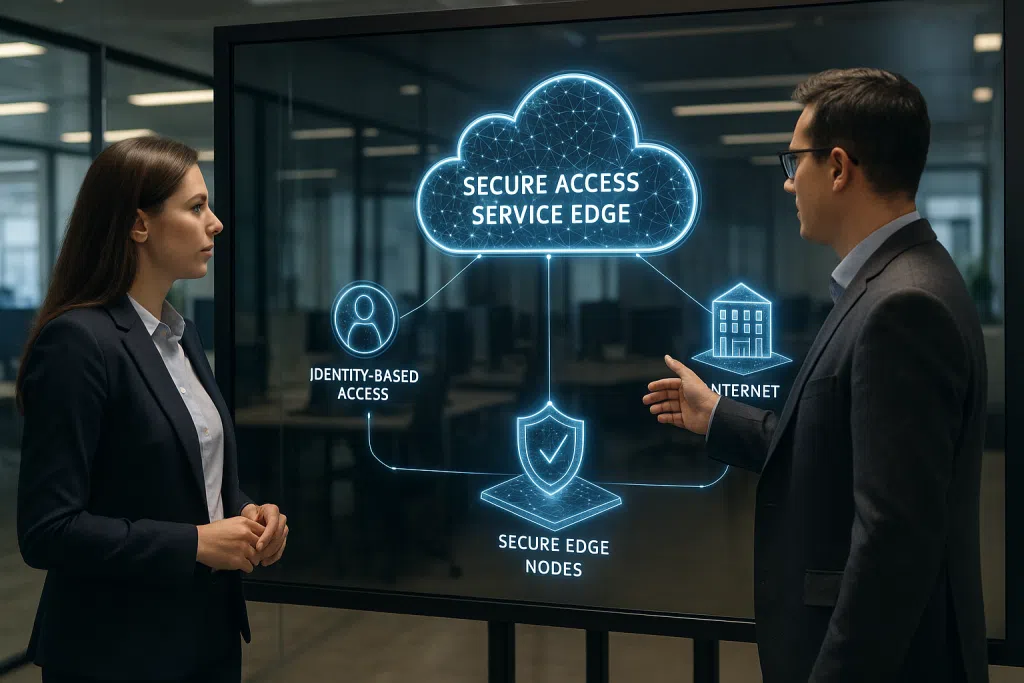
In an era defined by digital transformation, the term “SASE” has become a key point of discussion for organizations committed to secure, agile, and efficient network access. But what is the true SASE meaning, and why should businesses in healthcare, finance, legal, and other regulated sectors care? In this article, we break down the definition of SASE, or Secure Access Service Edge, explore its core technologies, and show how adopting a SASE framework is fast becoming essential for modern enterprises, especially small and mid-sized businesses (SMBs) facing compliance and risk challenges.
For regulated industries with growing remote workforces and cloud dependencies, understanding SASE isn’t just about following a trend; it’s about making informed, strategic decisions regarding security and connectivity. If you need tailored guidance on applying SASE technology to your unique environment, Book an initial Discovery meeting to discuss solutions for your business.
How SASE Redefines Networking: Explaining the Secure Access Service Edge Model
At its core, SASE stands for Secure Access Service Edge. This model represents a shift from traditional networking and security solutions to a cloud-native approach that integrates multiple security and networking functions into a single, unified service. The concept was first introduced by Gartner in 2019 as a response to new working models, increased cloud adoption, and the dispersal of IT resources outside classic office perimeters.
SASE combines wide area networking (WAN) and network security services, such as secure web gateways, cloud access security brokers (CASB), firewall as a service (FWaaS), and zero trust network access (ZTNA), into one comprehensive platform. Unlike the older method, which bolts security onto an existing network as a separate layer, a SASE network merges networking and security at the cloud edge.
In a practical sense, SASE brings together these critical capabilities:
- Identity-centric security: Each user, device, or application is verified before any access is granted. This matches well with zero trust principles, particularly vital for remote and hybrid teams.
- Policy-driven access: Organizations gain the ability to define specific policies, who can access what, from where, and under which conditions, great for sectors with compliance obligations like HIPAA or PCI-DSS.
- Unified threat protection and visibility: Core features like secure web gateways and intrusion prevention are built into every connection, enabling better oversight and real-time response to threats.
- Cloud-native architecture: SASE is delivered as a service from the cloud, eliminating the need for on-premises hardware and allowing businesses to scale quickly.
Before SASE, businesses were forced to string together multiple point-solutions, VPNs, various firewalls, hardware appliances, to protect networks and manage access for a spread-out workforce. This approach often resulted in complex, hard-to-maintain systems and frequent security gaps.
SASE technology changes this by consolidating these systems, making it more feasible to secure endpoints wherever they are, headquarters, branch offices, home offices, or even on the go. By aligning network traffic and security enforcement at the edge, the SASE framework increases speed, reduces latency, and improves compliance outcomes.
Healthcare clinics dealing with patient data or law firms that handle confidential legal documents find immense value, as SASE centralizes policy enforcement and streamlines compliance tasks. Finance and pharmaceutical companies benefit as well, gaining unified control over sensitive transactions and datasets without slowing down their users.
The movement towards SASE reflects broader shifts in the technology landscape, such as the proliferation of cloud services, growing mobile workforces, and the rise of AI-powered business tools. According to a recent study by TechTarget, nearly 45% of mid-sized enterprises plan to deploy SASE within the next two years as part of their remote work or digital security strategies. With the demand for flexible, always-on access rising, SASE offers a route to safer, more manageable connectivity.
If the concept appears complex, that’s because the stakes are high; every data breach or regulatory misstep can be devastating. That’s why an expert-driven introduction to SASE, tailored to the realities of healthcare, finance, or other compliance-driven sectors, has never been more critical. Book an initial Discovery meeting to see how SASE can fit with your organization’s needs.
Core Components and Architecture of SASE Networks
Understanding SASE meaning means understanding how its components fit together. The distinguishing feature of SASE is its architecture, which blends networking and security into a single, cloud-delivered service. While the marketing of SASE may sound broad, the real-world components are tightly defined.
Here are the main elements commonly found in a robust SASE framework:
1. Software-Defined Wide Area Networking (SD-WAN)
SD-WAN provides the essential foundation for SASE networks. This technology enables businesses to use multiple types of connections, including MPLS, broadband, and 4G/5G, to build secure, flexible connections between sites, users, and cloud applications. SD-WAN is favored for its ability to dynamically steer traffic based on the optimal path, reducing delays and bandwidth waste.
For organizations expanding across different regions or supporting hybrid work policies, SD-WAN removes the dependence on centralized, hardware-based data center networks. Instead, traffic can flow directly from remote offices or devices to cloud or SaaS resources, securely and with policy enforcement at every touchpoint.
2. Security-as-a-Service Components
SASE heavily relies on several security technologies delivered via the cloud:
- Secure Web Gateway (SWG): Inspects all web traffic for malicious activity, preventing access to dangerous or inappropriate content.
- Cloud Access Security Broker (CASB): Monitors, controls, and secures usage of cloud services (e.g., Microsoft 365, Google Workspace) to ensure sensitive data is not leaked or mishandled.
- Firewall as a Service (FWaaS): Moves traditional firewall functionality, from packet inspection to application-layer controls, into the cloud, making protection uniform across all locations.
- Zero Trust Network Access (ZTNA): Gives users access only to the specific systems or data required for their roles. This is especially important for remote work, healthcare providers, and legal firms who must strictly contain confidential information.
Each component addresses a weak link in legacy networks. With SASE, businesses don’t have to run multiple systems in parallel or try to stitch together disparate reporting tools.
3. Identity and Policy Management
A key part of SASE technology is that access decisions are based on identity, context, and real-time risk analysis, not on outdated network concepts such as “safe inside, unsafe outside.” This matches with Identity and Access Management (IAM) systems, Multi-Factor Authentication (MFA), and policy orchestration tools designed for regulatory compliance.
As user identities have become the new security perimeter, SASE architectures ensure every login and every cloud connection is scrutinized before access is allowed. It’s particularly valuable for compliance in healthcare (HIPAA), finance (FINRA), and legal sectors, where access control and audit trails must withstand strict scrutiny.
4. Continuous Threat Detection and Response
Unlike legacy solutions, which might only check traffic at the network’s edge, modern SASE platforms actively scan all traffic for anomalies and threats. Because of the centralized, cloud-native architecture, security intelligence and enforcement can be updated and rolled out instantly, reducing the window of opportunity for modern cyber threats.
5. Centralized Management and Analytics
SASE networks provide unified management dashboards to configure, monitor, and analyze network and security policies from a single interface. This is especially helpful for smaller IT teams managing multiple offices or compliance standards.
By tying these elements together, the SASE framework lets organizations replace a patchwork of security point-products with an integrated, cloud-delivered approach. The result is less administration, clearer policies, and much tighter security control.
Businesses in healthcare, legal, and financial services face unique regulatory demands, and a fragmented network security posture is a risk few can afford to take. SASE creates a level playing field, offering the tools midsized organizations need to meet compliance precisely and efficiently, even as IT environments become more complex.
Why Regulated SMBs Choose SASE Networks Over Legacy Security
The decision to move from legacy security stacks to SASE can be game-changing for small and mid-sized businesses, especially those operating under strict regulatory oversight. Traditional architectures, featuring hardware firewalls and scattered VPNs, were not designed for modern threats or a mobile workforce spread across locations.
Industry data from Cybersecurity Ventures reveals that cybercrime costs may reach $10.5 trillion annually by 2025. At the same time, roughly 43% of cyber attacks now target small to medium-sized businesses, according to the Verizon Data Breach Investigations Report 2025. With high costs per incident and increased legal liability, regulated SMBs cannot rely on outdated models.
SASE networks present major improvements:
- Consistent Security Everywhere: By applying the same rules and protections whether users are at headquarters, remote sites, or using mobile devices, SASE reduces attack surfaces.
- Agility and Scalability: Rapid deployment of new office locations or enabling secure access for new users is straightforward with SASE frameworks, essential for growing SMBs.
- Cost Reduction: Eliminating layers of hardware and reducing the software license sprawl leads to lower operating costs. IT staff spend less time managing equipment and troubleshooting compatibility issues.
- Automated Compliance Auditing: Many SASE solutions come with out-of-the-box policy templates for regulations like HIPAA, PCI-DSS, and GDPR, automating aspects of audit trails and reporting.
- Improved User Experience: Employees access apps securely from anywhere, with minimal friction. This boosts productivity and lessens support demands.
Use cases underscore these benefits. Consider a healthcare provider shifting to telehealth services or a law firm with attorneys working in multiple states: SASE platforms streamline secure access and auditability. For financial firms, where transmission of sensitive data is constant, SASE lets IT admins maintain granular control over transactions and reporting, without slowing down operations.
A 2025 Gartner survey found that 60% of organizations with a remote workforce of at least 30% now prioritize SASE for its unified security protections and support for Zero Trust network designs. In reality, businesses experience fewer breaches and compliance incidents when adopting a full-scale SASE framework.
Blending compliance automation, strong access control, and cost efficiency, SASE networks are built for regulated SMBs looking to safeguard both client trust and their bottom line.
If this shift aligns with your organization’s priorities, you can Book an initial Discovery meeting to get concrete answers tailored to your environment.
Key Differences: SASE vs. Legacy Network and Security Approaches
For organizations accustomed to traditional security models, understanding the differences between SASE and legacy approaches is crucial to making sound technology decisions. Comparing these models uncovers why the SASE meaning goes beyond mere buzzwords and drives measurable impact.
Legacy Network and Security Model
Traditionally, network security depended on a “castle and moat” design:
- Headquarters and branch offices are connected via leased lines or VPNs to a central data center.
- Security tools like firewalls, intrusion prevention systems, and content filters resided at just a few key locations.
- Remote access was managed through VPN clients, making scaling for remote or mobile users cumbersome.
- IT staff often juggled interfaces for each device or appliance across multiple vendors.
This setup, while once standard, now presents major downsides:
- Traffic Backhaul: All internet-bound data, even from branch offices or remote users, is often routed through the main office for inspection, leading to bandwidth bottlenecks and performance drops.
- Security Gaps: Point tools aren’t always in sync, and updates lag across sites. Users outside the network perimeter may be exposed.
- Resource Complexity: Every hardware refresh requires investment and skilled staff on site. The process is slow and often disrupts business operations.
- Limited Visibility: Monitoring threats or network usage across dozens of appliances is difficult, reducing forensic accuracy and compliance audit effectiveness.
SASE Network and Security Model
SASE brings a fundamentally new approach:
- Distributed Architecture: Security and networking are pushed to the cloud’s edge, close to users and the systems they access.
- Unified Security Stack: Functions like web filtering, zero trust access, malware prevention, and data loss prevention are consolidated on a single cloud platform.
- Identity-Focused Access: Access and policy decisions are dynamically enforced for every user, device, or application, regardless of location.
- Simple Scaling and Management: Because SASE is cloud-delivered, expanding or contracting services takes hours, not months.
This model means no more backhauling traffic, as internet and cloud-bound connections pass directly through local SASE nodes. As a result, employees working at client sites, from home, or on the go experience faster response times, reliable protection, and consistent access.
From a compliance standpoint, centralized reporting, built-in behavioral analytics, and integrated data leak prevention (DLP) offer in-depth visibility and easier evidence gathering for regulatory audits.
SASE technology reflects a shift from network-centric to user-centric strategy, a necessity as work-from-anywhere and software-as-a-service become standard for most professional service firms.
According to Forrester’s 2025 report on enterprise network security, organizations moving to SASE architectures have accelerated digital transformation projects, reduced time spent managing security devices, and elevated risk postures.
Roadmap to Adopting SASE: Best Practices for SMB Success
Transitioning to a SASE framework is not a one-time event; it’s a journey that requires technical planning and change management. Here is a roadmap SMBs can use to approach SASE adoption methodically.
1. Assess Business Needs and Compliance Gaps
Start by mapping out your environment: number of locations, remote users, critical applications, and data sensitivity. Identify compliance requirements like HIPAA, FINRA, or PCI-DSS. Review your existing network and security tools to locate inefficiencies, blind spots, or areas of risk.
A healthcare clinic, for example, might need to secure electronic medical records (EMR) across multiple physicians’ offices and cloud telehealth apps. Identifying these needs and gaps clarifies your priorities for SASE deployment.
2. Pilot SASE with Critical Users or Branches
Rather than attempting a full-scale shift, begin with a pilot. This might involve deploying SASE at a remote branch, implementing zero trust controls for remote staff, or migrating controls for a critical SaaS application like Microsoft 365.
A stepwise deployment allows for real-life testing, helps uncover unforeseen user experience issues, and validates security improvements.
3. Build a Phased Implementation Plan
Design a detailed SASE rollout covering:
- Migration from old VPNs or firewalls
- Policy and access control changes
- User training on new systems
- Integration with IAM or existing monitoring tools
Ensure milestones are practical and investments align with your IT and compliance budgets.
4. Leverage Managed SASE Platforms for Support
Partnering with an experienced service provider accelerates time to value and offloads the technical complexity of configuration, auditing, and maintenance. Managed SASE providers can craft policies to fit your industry, monitor threats 24/7, and streamline compliance reporting. With experts on call, internal IT teams can remain focused on business-critical projects.
5. Continuously Monitor and Optimize
Once the SASE architecture is live, monitor usage, security events, and network health via the platform’s analytics tools. Adjust policies as your environment evolves. Ongoing evaluation ensures that both security and business agility keep pace with company growth.
These best practices reduce the friction, risk, and cost associated with major technology changes. SMBs report faster migrations, fewer security incidents, and smoother compliance audits when following a structured roadmap for SASE adoption.
If your team wants to start this journey with the right partner or needs advice tailored to your compliance landscape, consider booking a Discovery meeting to review your roadmap options.
Real-World Examples: SASE Framework in Healthcare, Legal, and Finance
Let’s look at a few scenarios where SASE meaning is put into action, drawing from real challenges faced by regulated organizations.
Healthcare: Securing Patient Data Beyond the Office
A growing group of outpatient practices in New Jersey needed to secure patient data while expanding home-based telehealth and mobile care visits. Traditional VPNs slowed care coordination and risked noncompliance with HIPAA’s audit and access control standards.
Implementation of a SASE network allowed the clinics to create secure, encrypted channels between practitioners, EMR systems, and cloud-based diagnostic tools. Identity-based controls and audit trails simplified compliance reporting, while real-time malware filtering reduced the risk of data breaches.
Legal: Defending Client Confidentiality in Hybrid Work
A mid-sized law firm specializing in corporate litigation had offices spread across four cities and staff working remotely. Data privacy and document management had become unwieldy, with each branch supporting its own firewalls and VPN solutions.
Migrating to a SASE framework standardizes access policies and user authentication firmwide. Lawyers could collaborate securely on sensitive case files from any location, while integrated data loss prevention protected client confidentiality. IT could rapidly deploy or remove access as teams changed or cases closed.
Finance: Protecting Transactions and Ensuring Audit Readiness
A regional accounting firm, serving medical and pharmaceutical businesses, faced a rise in phishing attacks and remote fraud attempts. Its patchwork security systems made it hard to detect new threats or prove compliance with financial regulations.
Adopting SASE technology unifies threat intelligence, email filtering, and access control under one dashboard. Staff benefited from smoother connectivity to cloud-based finance and tax applications, reducing downtime. Automated compliance reports supported yearly audits without manual log reviews or policy exceptions.
An article by CSO Online outlines similar success stories across industries, reinforcing SASE’s value for SMBs in regulated sectors.
The lessons from these cases are clear: SASE frameworks address the gaps that legacy architectures cannot. From streamlining IT management to ensuring audit readiness and better user experiences, SASE is transforming the way organizations approach network security.
FAQ: Essential Answers About SASE
SASE stands for Secure Access Service Edge. Its main goal is to merge networking and security functions into a unified, cloud-delivered service that supports secure access from anywhere, not just from within traditional office networks. This model ensures consistent, policy-driven protection of data and users across distributed workforces, cloud applications, and remote locations.
A SASE network centralizes security controls and audit trails, making it easier to enforce regulatory requirements like HIPAA or PCI-DSS. With identity-based access and integrated threat detection, organizations can automatically document who accessed which systems, under what conditions, and demonstrate compliance during audits, no matter where employees are working.
Traditional VPNs and firewalls are often tied to physical locations and require manual management. SASE frameworks, by contrast, deliver security and connectivity via the cloud. This means flexible, always-on protection for remote users and branch offices, easier scaling for business growth, and a reduction in IT overhead costs.
SASE technology stacks usually include software-defined networking (such as SD-WAN), secure web gateways (SWG), cloud access security brokers (CASB), firewall as a service (FWaaS), and zero trust network access (ZTNA). These components work together to provide security, access control, and performance monitoring as a single, cloud-based service.
SASE is highly suitable for small and mid-sized businesses. It simplifies network management, reduces the number of vendors and products required, and delivers regulatory compliance features that are often out of reach with point solutions. Many SASE providers offer scalable pricing and support tailored for SMB needs, making it an accessible choice for regulated firms with limited IT resources.