






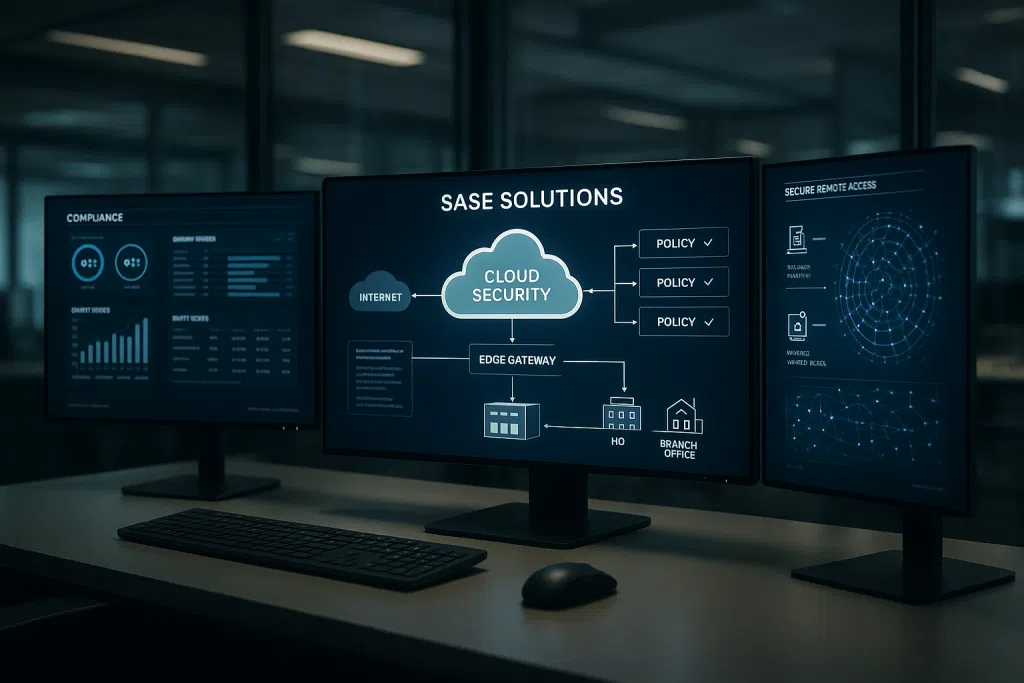
Secure, cloud-driven work environments are now the backbone of small and midsize businesses, especially in regulated fields like healthcare, finance, law, and pharmaceuticals. Yet, with growing dependence on cloud apps, hybrid workforces, and sensitive data comes a question leaders can’t afford to ignore: what are SASE solutions, and how can they provide practical, future-ready protection for your business? Understanding SASE, Secure Access Service Edge, isn’t just an item on your CIO’s checklist. For healthcare teams handling protected records, finance firms managing fund transfers, or law offices protecting client privilege, selecting the right SASE platform could make the difference between reliable compliance and costly, reputation-shattering incidents.
This article lays out SASE in plain English: what it is, why it matters, what core SASE components you should prioritize, and how to match SASE solutions with your security, compliance, and operational needs. You’ll also see examples tailored to co-managed IT and regulated sectors, along with key FAQ and actionable steps for decision-makers. If you want guidance for your specific scenario, you can always book an initial Discovery meeting right now.
Understanding SASE Solutions: Simplifying Secure Access for Modern SMBs
Ask nearly any IT professional or business leader about their biggest headache, and “balancing seamless connectivity with airtight security” is bound to make the shortlist. Businesses need tools and networks that support mobility, cloud use, and remote work without introducing excessive risk. That’s where SASE solutions, shorthand for Secure Access Service Edge, come in. Invented as a framework by Gartner in 2019, SASE bridges the gap between modern network demands and advanced security under a single, cloud-delivered umbrella.
At its core, a SASE platform integrates essential functions like secure web gateways, cloud access security broker (CASB), firewall-as-a-service (FWaaS), and zero trust network access (ZTNA) with the global reach and resilience of cloud infrastructure. Unlike legacy VPNs or on-premises firewalls, SASE isn’t just about building perimeter defenses; it puts both your users and your resources at the “edge” of the network, connecting securely from wherever teams work. Every session, whether a doctor logging into EMR from a remote clinic, a CPA accessing cloud accounting software, or a paralegal reviewing client files from a home office, is verified, encrypted, and tightly governed.
This centralized approach doesn’t just simplify IT management for SMBs; it also makes regulatory compliance much easier. For healthcare, finance, or legal organizations under strict data protection rules (HIPAA, PCI-DSS, FINRA), SASE solutions can let you enforce policies globally and prove auditability with less manual labor. But the benefits go beyond compliance and risk reduction. SASE cloud tools make onboarding new applications, supporting remote staff, and integrating AI-driven systems much less complex.
If your organization is outgrowing traditional VPN setups, needs clean cloud migration, or faces growing BYOD and remote user demands, now is the right time to explore SASE components that deliver both flexibility and security. Ready to see exactly how SASE can fit your unique business workflow? Book an initial Discovery meeting with Blueclone Networks now to take the next step.
Core SASE Components: What Should Owners and IT Leaders Evaluate?
Selecting SASE solutions isn’t a matter of one-size-fits-all. SMBs in regulated sectors face unique pressures, unplanned audits, cyber insurance requirements, diverse endpoints, and the unpredictability of hybrid operations. That’s why understanding the critical SASE components helps you avoid piecemeal security that leaves gaps open for attackers or compliance failures.
1. Identity-Centric Access Control (Zero Trust Network Access)
Zero trust isn’t just a buzzword; it’s the backbone of the SASE platform. With ZTNA, no user or device is automatically trusted, even inside the office network. Every login, every app session, is authenticated and monitored in real time. For instance, a pharmaceutical research assistant signing in from home to a cloud lab notebook is verified just as rigorously as an on-site tech in Princeton. This discipline dramatically reduces the pathways ransomware or insider threats can exploit.
2. Secure Web Gateway (SWG) and Cloud Access Security Broker (CASB)
These paired components act as advanced gatekeepers for internet and cloud app usage. An SWG filters, inspects, and blocks dangerous or non-compliant web traffic. CASB provides a granular view into who is using which cloud service (think Dropbox, Salesforce, e-prescribing portals), enforces policies, and even blocks upload/download of confidential files when risk is detected. Together, they are indispensable for legal firms bound by attorney–client privilege or medical practices under HIPAA.
3. Firewall-as-a-Service (FWaaS) Integrated with Intrusion Prevention
Rather than buying, installing, and patching on-premises firewalls, SASE cloud delivers always-updated, centrally managed firewall services that shield critical assets no matter where users connect from. FWaaS often couples with intrusion detection/prevention (IDS/IPS) features, providing detailed threat analytics and rapid response even if malware or exploits sneak through initial defenses.
4. Unified Policy and Compliance Management
SASE solutions excel at enforcing security and compliance policies uniformly; one dashboard for everywhere access is needed. IT teams can create rules (e.g., restrict uploading PHI outside of approved EHR apps, or block access to file-sharing sites for legal casework) and have them automatically applied to every connection, streamlining compliance with frameworks like HIPAA, PCI-DSS, SOX, and FINRA.
5. Continuous Monitoring and Reporting
Robust SASE platforms don’t just enforce controls; they monitor, log, and analyze every connection. This audit trail is essential for meeting compliance demands and for forensics in the event of a breach. Customizable reporting helps both in-house and co-managed IT teams keep senior management informed, pinpoint weak spots, and expedite incident investigations.
To illustrate, an SMB law firm in Trenton migrated to a SASE platform. Within weeks, staff could work securely from court, home, or client sites without worrying about public Wi-Fi threats or manual VPN logins. All web and app traffic was logged for audit, legal archives were only accessible via multi-factor authentication, and IT gained instant visibility into shadow IT risks.
SASE vs. Traditional Security: How Cloud-Delivered Frameworks Are Changing the Game
When business leaders ask, “Why can’t we keep using our current firewalls and VPNs?” it’s important to put SASE solutions in context with traditional IT models. Legacy methods focused on network perimeter security, keeping threats out, assuming everything inside the office or data center is trustworthy. As business went remote and cloud-first, that perimeter virtually disappeared.
Consider a healthcare clinic with staff switching between telehealth and office appointments, finance teams managing sensitive portfolios from satellite offices, or legal associates accessing files while on the move. Legacy VPNs become slow, complex, and prone to misconfiguration. Managing dozens of firewall appliances scattered across sites drains IT resources and cannot easily handle modern demands, like AI integrations, encrypted cloud communication, or constant device churn.
By contrast, SASE cloud frameworks move security controls closer to the end user, wherever they are physically located. Each user, device, app, and connection is evaluated based on company policies, real-time threat intelligence, and context such as user identity, device health, and location. This “contextual security” enables just-in-time access and instant revocation if risky behavior is detected.
Examples from regulated industries highlight the transformation:
- Healthcare: Instead of siloed tools and slow VPNs, SASE solutions provide secure, rapid access to EHR, telemedicine, and lab systems, enforcing compliance at every point of use. Audit reports can support HIPAA documentation effortlessly.
- Finance: Trading and advisory teams gain secure access to financial modeling software, while customer data moves only through encrypted channels. Regulatory policies (e.g., block downloads of sensitive reports from cloud drive on personal mobile devices) are enforced automatically.
- Legal: Attorneys and support staff can collaborate on litigation documents or client communications via cloud services without opening up lateral movement for attackers, as every connection is checked and segmented.
A recent Forrester survey referenced by TechTarget confirmed that SASE adoption reduces IT operational complexity and cuts breach response time compared to legacy stacks (TechTarget, 2025). Switching to a unified SASE platform often shrinks vendor lists, compliance admin, and incident investigation hours by 30–40% within the first year.
Matching SASE Solutions to Compliance, Cloud and AI Needs in Regulated SMBs
A big selling point for SASE solutions, beyond day-to-day convenience, is how naturally they align with the regulatory requirements of healthcare, finance, law, and other professional services. SASE platforms aren’t just modern firewalls and access controls; they’re tailored to support rulesets from HIPAA to SOX to PCI-DSS, while smoothing adoption of cloud and AI-driven workflows.
Streamlined Compliance for Tight Regulations
Few SMBs have the luxury of a giant compliance department, yet regulated sectors face growing oversight. Here’s how SASE components streamline compliance:
- Unified access control: Policies are created once and pushed out universally, updating in real time as codes or rulebooks change, such as updates from HHS or NIST.
- Automated activity logging: Every file accessed, session launched, and policy allowed/blocked is logged, timestamped, and easily retrieved for audit.
- Geo-fencing and content restrictions: For example, financial firms can restrict cloud access from overseas IPs, or healthcare offices can block cloud storage uploads of unencrypted client data.
This is highly relevant for firms seeking or maintaining cyber insurance. Insurance carriers now require proof of granular, enforceable policies and rapid incident response, capabilities “baked in” to most reputable SASE cloud platforms.
Supporting Cloud Migration and AI Integration
As SMBs in regulated industries embrace SaaS apps, cloud-hosted databases, and AI-augmented workflows, SASE platforms offer a secure foundation. Rather than complicating things, SASE helps IT leaders accelerate adoption safely:
- Cloud apps are pre-integrated: SASE vendors typically support the most-used software in healthcare, law, and finance, from Microsoft 365 to cloud-based EHR.
- AI agent access is governed: As AI marketing tools or document review bots are added, access is tightly controlled and audited, so only legitimate workflow automations connect to sensitive data.
- Scalable for seasonal or remote staff: Temporary contract attorneys, finance analysts during tax season, or healthcare staff at pop-up clinics can be added/removed quickly without gaps in oversight.
Co-Managed and In-House IT Advantages
SASE solutions shine in environments with hybrid support models, whether you have dedicated in-house IT staff or work in partnership with a co-managed MSP like Blueclone Networks. IT leaders maintain visibility across every session, quickly adjust policies for urgent situations (e.g., blocking access from a lost device), and provide board-ready compliance reports with minimal admin time. Vendor-neutral reporting also streamlines due diligence for mergers, acquisitions, or client audits.
When evaluating SASE providers, critical features for regulated SMBs include robust compliance certifications, customizable rule engines, and local support capable of understanding your specific audit and regulatory environment.
Ready to assess which SASE platform best fits your SMB? Book an initial Discovery meeting to get recommendations aligned with your compliance, cloud, and AI strategy. Reserve your spot here.
Key Factors to Consider When Choosing a SASE Platform
No two MSPs or SASE vendors are identical. As you research SASE solutions, knowing your sector’s priorities and the risks you’re seeking to mitigate will help avoid future headaches. Based on real SMB deployments across New Jersey and beyond, these are the top considerations leaders should review:
Regulatory Fit and Audit Support
A strong SASE platform should offer not just generic controls, but the precise policies, reporting, and certification support needed by your business. Healthcare offices should look for detailed HIPAA alignment; finance and law firms need granular rules for confidentiality and transaction monitoring. Robust platforms will also aid with annual audits and documentation for compliance officers or third-party reviewers.
User Experience and Remote Performance
If SASE adoption adds friction, slow login, laggy app access, and constant reauthentication, users will find workarounds, opening up new risks. Ask for demos and performance stats from peer SMBs before deciding. Leading solutions offer lightweight agents, transparent mobile access, and minimal manual steps.
Integration with Existing Tools
An ideal SASE platform won’t force a rip-and-replace of your entire network or security stack. The best solutions easily connect with legacy on-premises resources, Active Directory/identity management, and common SaaS platforms. Look for compatibility with cloud security standards and support for multi-cloud environments.
Customization and Ongoing Support
Compliance, cyber threats, and workforce needs will keep evolving. Choose a vendor offering customizable policy engines, regular upgrades, and live, local support, especially valuable for regulated, regionally-focused SMBs. Support contracts that include proactive compliance guidance or co-managed IT options add extra value.
Transparent Cost Structure
SASE is typically licensed per user or per site; avoid solutions with hidden fees for features you may not need (such as proprietary hardware or bundled services unrelated to your requirements). Transparent, predictable billing is especially important for budget-aware SMBs.
Real-World Example: A Central NJ healthcare group, managing multiple clinics and a remote telemedicine staff, transitioned to a SASE solution. The outcome: HIPAA violations risk dropped, cloud app onboarding accelerated, and helpdesk tickets related to remote access fell by over one third in the first six months.
For more insights, readers can reference the 2025 Gartner “Market Guide for Single-Vendor SASE” (Gartner, May 2025), which highlights evaluation strategies for SMBs.
SASE Solutions for Hybrid, Regulated SMBs: Best Practices and Implementation Tips
SASE implementation doesn’t happen overnight, but following proven best practices will ease migration and ensure your team gains real benefits, protection, compliance, and operational simplicity. Here’s how regulated SMBs are succeeding:
1. Start with a Risk and Workflow Assessment
Map out the critical systems, sensitive data, and most common workflows, whether cloud-based medical records, shared financial ledgers, or confidential case management software. Document current pain points (like VPN bottlenecks or shadow IT use) and define desired outcomes (faster onboarding, better compliance logs, AI readiness).
2. Prioritize Identity and Device Management
Secure access service edge is only as strong as its identity controls. Implement strong multi-factor authentication (MFA), conditional access, and device health checks. Integrate SASE components with existing IAM solutions wherever possible.
3. Pilot, Measure, and Iterate
Instead of a “big bang” rollout, launch SASE for a pilot group, perhaps your legal research staff or remote field nurses. Use real usage and performance data to adjust policies and optimize workflows. Make changes quickly and communicate improvements clearly to users.
4. Coordinate with Co-Managed or External IT Partners
If you use a hybrid support model, involve partners such as Blueclone early. Co-managed IT brings deep experience with SASE migrations in similar SMB settings, from compliance mapping to seamless helpdesk escalation. They can handle tuning of security rules, user training, policy documentation, and even coordination of incident response.
5. Educate Staff and Align on Policies
Human error remains a frequent root cause of security breaches. Ongoing user education, covering safe remote work habits, recognizing phishing attempts, and understanding the basics of secure app use, is essential. Many SASE providers offer training modules or in-product tips, which can be customized by IT leaders.
6. Monitor, Report, and Improve
With SASE solutions, continuous monitoring is built-in. Schedule periodic reviews of access logs, policy violations, and incident reports to fine-tune security posture and spot gaps early. Regular reporting satisfies both compliance and executive leadership needs.
Implementation Spotlight: A Princeton-based CPA firm adopted a SASE platform before tax season. Even as seasonal staff joined and worked in hybrid mode, compliance reports on client data access and upload/download activity could be produced instantly, meeting AICPA audit requirements with zero manual log consolidation.
Want a walkthrough tailored to your workload and compliance challenges? Book an initial Discovery meeting here to explore your next steps.
Frequently Asked Questions About SASE Solutions for Regulated SMBs
A SASE solution, or Secure Access Service Edge, combines network and security functions like firewalls, secure web gateways, and zero-trust access into a single cloud-delivered platform. Unlike traditional, perimeter-focused tools such as standalone firewalls and VPNs, SASE enforces security everywhere your users connect, from the office, home, or anywhere else, offering better visibility, flexible policy enforcement, and streamlined compliance management.
These sectors face strict data privacy and compliance rules, remote work demands, and increasingly sophisticated cyber threats. SASE platforms provide identity-centric security, real-time policy enforcement, and unified monitoring/logging, making it easier for SMBs to protect sensitive data, meet audit requirements, and support both remote and onsite teams securely.
Prioritize platforms that offer integrated zero trust network access (ZTNA), secure web gateways (SWG), cloud access security broker (CASB), firewall-as-a-service (FWaaS), and centralized policy management. Strong reporting, compatibility with existing cloud/AI workflows, and proof of compliance certifications are also critical, especially for regulated organizations.
Absolutely. SASE platforms are designed for hybrid and cloud-first operations, protecting cloud apps, encrypted communications, and AI workflows. Access is managed and monitored with detailed controls, so whether you’re onboarding new SaaS for remote staff or integrating AI marketing tools, you stay compliant and protected.
Begin by evaluating your risk profile, compliance requirements, and current IT pain points. Collaborate with experienced IT partners familiar with regulated industries, like Blueclone Networks, to assess options and design a phased SASE rollout. Training, policy development, and ongoing monitoring complete the journey to safer, more agile operations.