


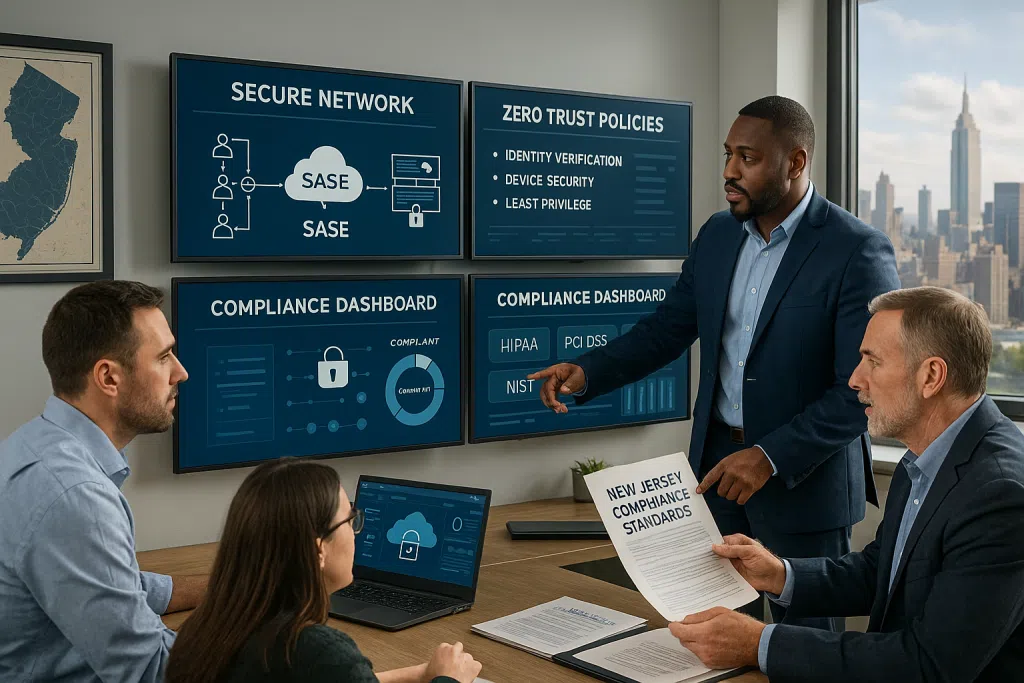
Secure Access Service Edge, widely referred to as SASE network security, has rapidly shifted from buzzword to business necessity across highly regulated sectors in New Jersey and throughout the United States. The security demands of healthcare, finance, law, and pharmaceutical small-to-midsize businesses (SMBs) have grown alongside an explosion of remote work, cloud computing, and regulatory oversight. As a result, SMBs in the region are rethinking how they defend their data, support compliance, and future-proof their IT investments.
This article explores the fundamentals of SASE network architecture, why it is gaining traction for organizations balancing compliance with flexibility, and how your business can adopt the best SASE solutions for a smarter and safer digital environment. If enhancing your cybersecurity compliance posture is a top priority, now is the time to understand how SASE can become the backbone of your IT strategy.
Ready to map out a SASE-powered security plan tailored to your industry? Book an initial Discovery meeting with Blueclone Networks for actionable, plain-English guidance.
SASE Network Security Defined: Core Concepts, Benefits, and Compliance
SASE network security refers to the convergence of network and security functions into a unified, cloud-based service. First coined by Gartner in 2019, Secure Access Service Edge (SASE) has since evolved into a go-to solution for SMBs juggling data protection and remote work requirements.
At its foundation, SASE blends technologies such as Zero Trust Network Access (ZTNA), cloud access security broker (CASB), firewall-as-a-service (FWaaS), secure web gateway (SWG), and software-defined wide area networking (SD-WAN). For small and medium-sized businesses in health, legal, finance, and pharma across New Jersey, SASE network architecture presents a practical alternative to the patchwork of legacy point solutions and aging on-premise hardware.
Why is SASE more than just another security upgrade for compliance-heavy industries?
- Single, Cloud-Delivered Control: All network traffic, whether from remote users, branch offices, or IoT devices, flows securely through cloud-based policy enforcement points. This removes the need for siloed on-site firewalls, fragmented VPNs, or complex manual configurations that can lead to accidental exposures.
- Continuous Security and Monitoring: With integrated threat detection, identity access controls, and real-time monitoring, businesses achieve consistent security regardless of where data or users reside. For HIPAA, PCI-DSS, or FINRA-regulated firms, this makes audits more manageable and breaches less likely.
- Scalable, User-Centric Access: Traditional security tools often “trust” users inside the network perimeter. SASE flips this approach, granting precise, time-bound access to only the resources individual users or devices need, regardless of their location. This Zero Trust foundation is now considered a baseline for modern cybersecurity SASE strategies.
- Lower Cost, Leaner Operations: Cloud-managed SASE solutions eliminate the need for frequent hardware refreshes, reduce ongoing maintenance labor, and consolidate costs into a predictable monthly spend. This transparency aligns well with budgeting and reporting expectations under cybersecurity compliance frameworks.
Local Example:
A medical group in Princeton, facing rapid growth and strict state/federal privacy rules, recently adopted SASE to unify its multi-site networks and enable secure telehealth. As a result, their IT team now manages access and compliance controls for onsite and remote staff through a single interface, drastically improving response times during audits or incidents.
With these core advantages, SASE is uniquely suited to industries where fast-moving regulations, distributed workforces, and client confidentiality are top of mind. For many local SMBs, it’s not a matter of if but when this shift will happen.
Curious about your organization’s readiness for SASE network security and compliance? Book an initial Discovery meeting to get started with an in-depth, jargon-free consultation.
Understanding SASE Network Architecture in Practice
Breaking away from the traditional castle-and-moat approach, SASE network architecture restructures how access and data are handled across your IT ecosystem. Instead of securing only a central office and hoping remote connections are trustworthy, SASE treats every user, device, and application as potentially untrusted until authenticated.
Key Components and Flow in SASE Network Architecture:
SD-WAN Integration:
- Software-Defined Wide Area Networking (SD-WAN) allows optimal traffic routing between sites, branches, and users. Traffic moves over secure, cloud-managed tunnels, reducing latency and improving app performance.
Cloud-Delivered Security Stack:
- All network traffic passes through SASE’s security layers in the cloud. This stack includes web filtering, malware scanning, data loss prevention, and intrusion detection, protecting users and data without backhauling everything to a physical headquarters.
Identity and Context Awareness:
- Using multifactor authentication, role-based access, and behavior analytics, SASE platforms ensure that only authorized individuals reach sensitive data. Access can be refined by time, geography, and even device health.
Continuous Policy Enforcement:
- Policies for data access, compliance needs, or content restrictions are defined centrally and enforced no matter where users connect. For example, an attorney logging in from home and another at the office receive the same protections and restrictions.
SASE and Cybersecurity Compliance:
Compliance is often cited as one of the primary drivers for SASE adoption in healthcare, legal, and finance. Each regulatory framework, be it HIPAA for health data, PCI-DSS for payments, or FINRA for financial firms, demands meticulous controls over data access, movement, and retention.
SASE directly supports these requirements by:
- Auditing every access attempt and recording it for review.
- Automating compliance enforcement (such as encryption in transit, malware filtering, or logging).
- Enabling rapid response to incidents, with centralized visibility into user and app activity.
Data Point:
According to IDC’s 2024 security report, organizations transitioning to SASE reduced compliance-related incidents by 31% compared to those relying solely on traditional firewalls and VPNs. Unified policy management and full-session recording were standout contributors to this reduction.
With regulatory pressures only expected to increase, especially as AI and remote work expand data boundaries, a robust SASE network architecture ensures your policies keep up with both hackers and auditors.
Evaluating the Best SASE Solutions for Compliance-Focused SMBs
Choosing the right SASE platform can seem daunting amid a crowded market and abundant technical jargon. For compliance-driven SMBs and co-managed internal IT teams, it’s crucial to focus on criteria that move beyond “checkbox” security and prioritize transparency, scalability, and support.
Key Considerations for Selecting the Best SASE Solutions:
Vendor Track Record & Industry Experience:
- Look for managed IT partners or SASE vendors with expertise serving regulated sectors. Experienced providers understand specific threats facing New Jersey healthcare, legal, and finance organizations, and they regularly advise on compliance audits, risk assessment, and remediation.
Data Location and Privacy Controls:
- Ensure your SASE provider maintains strict control over where data is processed and stored. This is especially vital for HIPAA and GLBA compliance, where breaches or data residency issues often trigger steep penalties.
Zero Trust and Strong Authentication:
- Evaluate capabilities for multifactor authentication, device health checks, and granular policy controls. The best SASE solutions consistently verify user identities, reducing the risk of credential theft or privilege escalation.
Cloud Service Integration:
- A robust SASE platform integrates with the business tools your teams rely on, including Microsoft 365, Google Workspace, and industry-specific CRMs or EHRs. Smooth compatibility streamlines workflows and reduces onboarding friction for staff.
Local, Responsive Support:
- For businesses balancing lean IT teams and time-sensitive compliance reporting, rapid support matters. Choose vendors that offer real-time helpdesk access, local technical resources, and proven disaster recovery plans.
Case-in-Point:
A mid-sized Trenton law firm reduced annual compliance costs by shifting from patchwork endpoint tools to a single SASE platform managed by a New Jersey-based IT partner. This allowed their in-house IT staff to focus on supporting attorneys instead of troubleshooting dozens of separate products, while the new system automatically logged security events for future audits.
When comparing SASE offerings, avoid being swayed solely by national advertising or “all-in-one” claims. Focus on solutions tested within your sector and region, and ask for references from similar organizations. A partnership mindset and a roadmap for scaling will keep your cybersecurity SASE journey aligned with your business growth.
Want a customized SASE solution comparison for your compliance needs? Book an initial Discovery meeting with network specialists who speak your industry’s language.
SASE in the Real World: Use Cases for Healthcare, Legal, Finance, and Pharma
SASE isn’t simply an upgrade for remote work; it is a strategic shift in streamlining security, enhancing compliance, and supporting digital innovation for regulated industries.
Healthcare: Protecting Patient Data and Enabling Telehealth
Healthcare practices, clinics, and billing organizations face intense scrutiny over data breaches and ransomware attacks. Traditional perimeter-based security falls short once staff access records from home or multiple clinic sites. SASE addresses core pain points:
- Unified Protection for electronic health records (EHRs), patient portals, and telehealth video calls.
- Context-Based Access for clinicians, limiting exposure if a credential is compromised.
- Support for HIPAA Compliance with centralized audit trails, automated encryption, and real-time policy alerts.
A multisite provider in New Jersey used SASE to enable flexible work while meeting HIPAA’s strict security rule. Their managers now have a single dashboard for access control and reporting, streamlining annual compliance certification.
Legal Firms: Preserving Client Confidentiality and Satisfying Regulatory Demands
Attorneys and law offices manage confidential case data and increasingly face client-driven cybersecurity compliance requirements. SASE supports risk-mitigation in these environments by:
- Providing Zero Trust access to sensitive legal files and email from courthouse, office, or remote locations.
- Automatically logging access attempts and data transfers for e-discovery or breach forensics.
- Democratizing security so partners, paralegals, and clerks are protected without constant IT intervention.
For a regional firm, switching to a managed SASE platform meant retiring legacy VPNs prone to misconfiguration and reducing IT compliance workload during legal audits.
Finance & CPA Firms: Defending Against Fraud and Meeting Audit Standards
Financial and accounting professionals confront a mix of PCI, GLBA, IRS, and even state-level mandates. Their business clients rely on assurances that personal and business financial data won’t fall into the wrong hands.
- SASE’s full-session recording and automatic threat response help firms prove due diligence during audits.
- Integration with SaaS portfolio and document management solutions keeps workflows efficient and secure.
- Real-time threat intelligence cuts exposure from phishing, social engineering, and zero-day malware.
A Princeton-based CPA firm reported a measurable uptick in security event prevention after moving to SASE, with fewer urgent calls tracking down suspicious logins or document sharing.
Pharmaceuticals: Intellectual Property, Supply Chain, and FDA Requirements
The fast-paced nature of pharmaceuticals means teams may work at labs, manufacturing sites, client facilities, or even from home. SASE helps organizations:
- Restrict lab data or clinical trial records to known users/devices, at authorized locations only.
- Map data flows to meet FDA and international privacy mandates.
- Quickly segment or revoke access for departing staff or contractors.
According to a 2024 white paper from CSO Online, pharma firms leveraging cloud-native SASE reduced their third-party vendor data exposure by almost 40%, underscoring the approach’s practical benefits for safeguarding trade secrets and innovation.
Need advice on transitioning to SASE in your industry? Book an initial Discovery meeting with compliance-proven SASE advisors.
Overcoming Adoption Challenges: Security, Culture, and Ongoing Optimization
Implementing a new SASE architecture is a serious strategic shift for any SMB, especially one subject to changing regulations and evolving cyberattacks. As with any technology initiative, there are hurdles, both technical and human, that businesses must account for.
Common Challenges and Solutions
Migrating from Legacy Tools
- Old firewalls, VPN appliances, and piecemeal monitoring tools may be deeply woven into day-to-day operations, especially in smaller organizations or firms with established workflows. Moving to SASE requires careful mapping of current processes and phased migration to prevent disruption.
Training Staff Across All Levels
- SASE centralizes security, but its controls are only as good as the teams behind them. Ongoing education for employees, from front desk to senior management, on new authentication, access policies, and incident reporting procedures is paramount.
Aligning with Third-Party Vendors and Partners
- In regulated sectors, data often flows through numerous external service providers. Ensuring that partners are compliant and can interface with your SASE solution is essential. This might involve conducting vendor risk assessments and updating agreements based on your new security posture.
Ensuring Continuous Optimization
- Threat landscapes and compliance rules do not stand still. Effective SASE network security solutions incorporate regular review of access logs, policy adjustments, user behavior analysis, and “red team” penetration tests to close new vulnerabilities.
According to a 2024 report from the Ponemon Institute, organizations that scheduled quarterly SASE policy reviews and staff refresher training experienced 26% fewer compliance gaps compared to those that relegated updates to annual cycles.
The Role of Co-Managed IT and Specialized Partners
Many healthcare clinics, legal firms, and finance companies run lean IT teams that focus on daily operational support rather than ongoing security research and optimization. Co-managed service models, where local IT leads work with outside SASE specialists, offer a viable approach. Internal staff keep day-to-day control, while external security professionals handle expert setup, 24/7 monitoring, and compliance audits.
Seeking a partner like Blueclone Networks means regular technology “health checks,” actionable reporting, and an evolving strategy tailored to your sector. This partnership ensures that as the regulatory environment shifts or new threats emerge, your organization doesn’t just react but proactively adapts.
The Future of SMB Cybersecurity: SASE as a Foundation for Digital Innovation
The pace of digital transformation is unlikely to slow for organizations serving sensitive clients or tightly regulated industries. Cloud adoption, AI integration, hybrid work, and new SaaS business applications all bring productivity benefits but also introduce complex compliance and security challenges.
SASE provides a next-generation foundation that future-proofs the business while opening doors to new ways of serving clients and collaborating securely. Rather than relying on bolt-on tools or hoping legacy systems will hold, SMBs are increasingly designing their IT strategy from the ground up with SASE in mind.
- Work Anywhere, Securely: Staff can serve patients, clients, or partners from a branch, home, or mobile device with the same assurance of protection.
- Elastic Security for Growth: As your business acquires new clients, opens new offices, or adopts emerging AI tools, SASE platforms allow rapid expansion, without rewriting core security policies.
- Lower, Predictable Costs: The cloud-based model turns major hardware outlays into affordable, transparent subscriptions. This model supports compliance, planning, and minimizes unpleasant surprises during audits.
Expert Resource:
For up-to-date benchmarking and best practices, the National Institute of Standards and Technology’s (NIST) 2024 security guidance on SASE outlines the benefits for regulated industries and how to ensure compliance alignment. Read the official NIST SASE guidance for more details.
Forward-looking businesses view SASE as more than a cybersecurity SASE “upgrade”, it forms the basis for AI adoption, secure collaboration, and nimble response to whatever tomorrow may bring in compliance or threat evolution.
Frequently Asked Questions
SASE network security unifies network and security policies in the cloud, providing stricter access controls, instant logging, and automated security tool updates. These features meet the data privacy and documentation demands found in HIPAA, FINRA, or PCI frameworks. Its Zero Trust approach further prevents unauthorized access, a critical gap in many legacy systems across regulated fields.
Traditional models secure a fixed network perimeter and often “trust” internal users by default. In contrast, SASE delivers security as a service through the cloud and evaluates every user, device, and connection in real time, no matter their location. Security controls, threat filtering, and compliance monitoring happen automatically with every request, removing the risk of outdated firewall configurations or misused VPNs.
Costs vary depending on organization size, number of users/locations, and integration needs. However, many SMBs find SASE solutions to be more affordable than maintaining multiple outdated firewall appliances or on-premises servers. The predictable, subscription-based pricing aligns with most audit and budget cycles, making technology upgrades easier to justify.
Yes, leading SASE vendors support integration with Microsoft 365, Google Workspace, and a wide range of SaaS or AI-powered applications. This allows companies to manage both security and productivity tools under unified access policies, trimming duplicate logins, enforcement gaps, and onboarding complexity.
Start with a candid assessment of your current cybersecurity tools and compliance needs, then develop a migration roadmap that prioritizes business-critical workflows. Engage both internal IT leaders and outside experts in this planning. Phased rollouts with clear communication and staff training reduce friction and help everyone adapt smoothly to new policies and platforms.


