






Changing Attack Tactics: Are Your Secure Emails Really Safe?
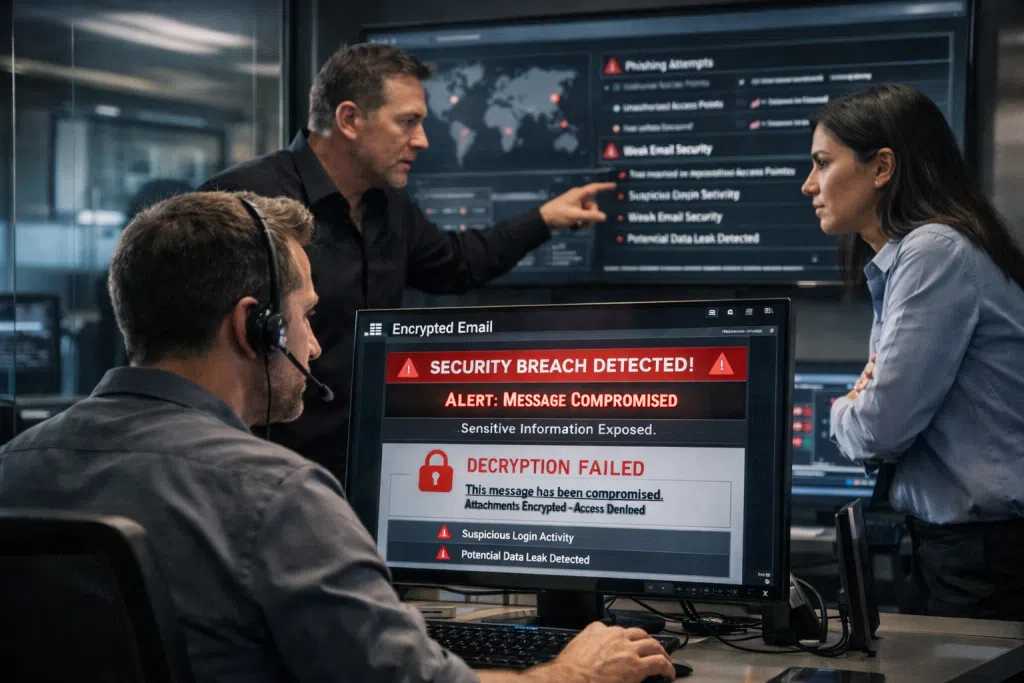
For years, business leaders in healthcare, finance, law, and other regulated sectors have invested in secure email platforms, trusting them to safeguard sensitive communications. But despite advanced layers of technology, encrypted channels, multi-factor authentication, sophisticated spam filters, there are still headlines about secure email systems being breached. This has left many decision makers asking: if I’ve implemented secure email, why does risk persist?
To tackle this question, it’s vital to look beyond the buzzwords and dig into why security isn’t absolute, even with the latest tools. Secure email solutions create a fortified perimeter and, in many cases, encrypt messages in transit and at rest. However, that alone often isn’t enough. Attackers are evolving just as quickly, and their methods exploit gaps that aren’t covered by encryption or classic security alone. They target users with social engineering, leverage weaknesses in business processes, and use clever technology to bypass protections.
Consider recent breaches where attackers slipped through even the most respected secure mail hosting providers by using compromised employee credentials obtained from unrelated phishing attempts. In some cases, a clicked link or an unwitting password reuse inside a finance or legal team allowed attackers to sidestep all the complex encryptions and access business communications directly. It isn’t purely a technology problem, it’s a blend of process weaknesses and human fallibility.
In industries facing HIPAA, PCI-DSS, FDA, or FINRA regulations, the stakes are higher. Sensitive customer information, medical files, and high-value contracts all travel over email. A single incident can trigger audits, damaging your reputation and resulting in costly penalties. Even with secure business email, organizations still fall prey to data loss because attackers bypass security controls rather than break them head-on.
Understanding these realities isn’t about inspiring fear, it’s about guiding smarter, more holistic protection. Firms need more than encryption; they also need employee training, process checks, ongoing monitoring, and responsive incident plans. If you’re wondering how your current secure email strategy holds up or suspect you’re missing a critical layer of defense, don’t wait, take action now. Connect with Blueclone Networks now to schedule a business-focused email security check and close the gaps before they become tomorrow’s headlines: Schedule a Consultation.
Insider Threats and Social Engineering: The Human Factor in Secure Email Breaches
When examining secure email breaches that make the news, a striking pattern emerges: technology is only as good as the people and processes using it. Technology stacks like secure email gateways, encrypted message transfer, and secure mail hosting are now standard in regulated SMBs. Yet incidents persist, often due to clever manipulation, not technological weaknesses.
Research published in 2025 by Verizon’s Data Breach Investigations Report points to the ongoing dominance of social engineering as a primary attack vector in email cybersecurity. Phishing emails, spear-phishing campaigns, and business email compromise (BEC) are responsible for more than 80% of email-based security incidents in small and midsized organizations. Attackers today don’t need to “hack” into an account. Instead, they masquerade as trusted contacts, create urgent, believable requests, or craft emails that mimic vendors, clients, or even executives within your organization.
One classic attack involves a criminal impersonating a law firm partner and sending instructions to a junior staffer, convincing them to transmit a wire payment or send sensitive files. Another relies on spoofed healthcare invoices that trick medical office employees into entering credentials on a fake login page. These scenarios prove that even a secure business email environment can be subverted with a successful deception.
But insider threats go deeper than external actors pretending to be someone else. Sometimes, well-intentioned staff can become unwitting accomplices by clicking a malicious link, forwarding sensitive documents without proper re-encryption, or failing to follow established compliance steps. External contractors and co-managed IT staff sometimes operate outside established controls, potentially exposing systems as well.
Blueclone Networks has assisted several professional firms in New Jersey and across the nation, where post-incident investigation traced data exposure back to a team member who overlooked one detail: confirming a sender’s authenticity. Regular employee awareness training, simulated phishing campaigns, and clear reporting protocols make the difference between a contained risk and a disastrous breach. Regardless of your secure email setup, if users aren’t regularly educated and motivated to spot suspicious activity, your security posture falls short.
It’s crucial for business leaders to pair secure mail hosting with a living, evolving process of awareness and internal communication. Not only can this approach prevent data loss, but it also fosters a security-first culture within your organization. Ready to empower your team and reinforce your secure business email solution? Connect with Blueclone Networks now to arrange a tailored training session or phishing simulation and improve your resilience.
Gaps in Email Security Technology: What Encryption Can’t Cover
The common assumption is that encrypted email and sophisticated filters provide full-spectrum defense, but that belief can turn dangerous. Encryption is vital; it protects messages in transit and ensures that only intended recipients can decrypt and view sensitive content. However, a closer evaluation reveals that encryption doesn’t prevent breaches occurring after decryption, nor does it block threats embedded in attachments or malicious URLs.
Emails, once decrypted by a user, become as vulnerable as the endpoint’s overall protection allows. If an employee receives a secure email on a compromised device, infected by malware or running unpatched software, attackers can potentially access the unlocked message like any other file. Modern ransomware groups frequently exploit this route, targeting critical files attached to emails or scraping decrypted inboxes.
Additionally, most secure business email platforms offer basic anti-malware and spam filtering as part of their standard service. Yet sophisticated actors know how to engineer attachments or links that evade pattern-matching filters. According to a recent Microsoft report on advanced cyber threats, adversaries are increasingly using “living off the land” techniques, embedding their attacks in standard office documents or hiding them behind cloud collaboration links.
Another overlooked technology gap is the lack of real-time behavioral analysis in many secure email solutions. Attackers may compromise a legitimate mailbox and then send emails internally that appear trustworthy, carrying out a “lateral phishing” attack. Because the sender is trusted and already inside your network, standard secure mail hosting filters may never flag the activity.
Even basic protocols like SPF, DKIM, and DMARC, which help verify senders and prevent spoofing, are not always fully implemented or monitored. These email security standards play a critical role in authenticating messages, yet many businesses never revisit their configurations after the initial rollout. Without routine email security checks and configuration reviews, these defenses weaken over time, making even a “secure” system vulnerable.
Ensuring a modern, multi-layered approach, combining endpoint security, behavioral analytics, regular system audits, and proactive process reviews, is the best way to close these persistent gaps. Secure business email should always be paired with routine technology assessments. Are you confident your email protection stack does more than just encrypt? If not, engage an experienced service provider to run a comprehensive assessment tailored to your risk profile.
Compliance Requirements: Email Protection Mistakes That Invite Breaches
Regulatory standards, such as HIPAA for healthcare, PCI-DSS for finance, and FINRA for investment firms, mandate strict oversight of information transmitted via email. But technical compliance doesn’t always equal real protection. Many businesses believe that using a secure email provider or encrypted messaging automatically checks the compliance box, but the reality is often messier.
Common email cyber security mistakes that undermine compliance include storing sensitive emails or attachments in unprotected archives, forwarding confidential messages outside the intended workflow, or failing to monitor access logs for unauthorized activity. Healthcare practices, for instance, often fall into the trap of sending legacy medical records as unencrypted attachments or storing them on unsecured cloud storage, believing that the initial email transmission’s encryption is enough.
Finance and law firms face unique regulatory tech challenges, as client communications and signed contracts routinely change hands via email. If secure mail hosting is used inconsistently or not enforced as policy for all staff, a single overlooked message can create compliance gaps. For example, if only senior partners use encrypted email while junior staff default to standard systems, the weakest link defeats the strongest chain.
According to HealthITSecurity’s 2026 compliance findings, email remains the root cause of most HIPAA data breaches, specifically due to workflow mistakes, overlooked archiving, and lack of regular audits. Firms that rely on a “set it and forget it” approach to email protection often only discover their blind spots after a regulatory incident or client complaint.
Blueclone Networks encourages clients to conduct regular compliance drills, carefully mapping how data moves in and out of each mailbox and flagging partners or applications that could introduce risk. Email security checks should be part of quarterly or annual compliance reviews, not just a one-time event.
Policies should be clear: all sensitive emails and attachments must follow strict protection protocols at every stage (sending, receiving, storing, and archiving). Audit trails, tamperproof logs, and access monitoring are minimum requirements for regulated industries. Failure to maintain these practices doesn’t just lead to regulatory fines, it erodes client trust and can permanently harm professional reputation.
Reviewing your own compliance posture? Reach out to your IT and compliance partners, and consider a neutral assessment. Making sure your secure business email is truly compliant and not just “checking a box” is essential for protecting your organization and clients.
Advanced Threats: Phishing, Ransomware, and Business Email Compromise in Modern Attacks
Cyber attackers have fine-tuned their approach, blending multiple methods to increase their chance of success, and even the best secure email solutions are targets. Among the most concerning risks today are phishing schemes, ransomware payloads, and business email compromise (BEC). The common thread: each attacks the points of greatest trust within your communication environment.
Phishing has evolved far beyond the “Nigerian prince” scams of the past. Attackers craft sophisticated, targeted emails that reference real colleagues, clients, or business deals. They register domains that look nearly identical to your own. Once a victim clicks a poisoned link or opens a malicious document, attackers capture credentials or gain a beachhead inside the organization’s infrastructure.
Business email compromise is especially costly. Criminals monitor inboxes quietly after gaining access, waiting for opportunities to redirect legitimate payments, intercept contracts, or manipulate executive communications. According to the FBI’s 2026 IC3 Report, losses from BEC schemes in the US exceeded $2.9 billion in just one year, much of it sourced from small and mid-sized businesses.
Ransomware gangs now target email backups and archives, knowing that many organizations store years of email data in cloud platforms. Encrypting all those records disrupts business continuity and increases extortion leverage. Even firms that thought their secure mail hosting was infallible have learned otherwise when cybercriminals derail operations using a single exploited inbox.
For SMBs in healthcare, legal, and finance, the risks compound as sensitive data becomes more attractive to thieves. Simply put: secure email technology alone cannot stop every attacker who is determined, well-funded, or able to exploit a momentary lapse.
Blueclone Networks often works with organizations to recover from these advanced threats, and the most effective response always involves multiple lines of defense. Multi-factor authentication, routine phishing simulations, tightly controlled administrator accounts, and regular reviews of external sharing permissions are now required tactics in any cyber defense playbook.
Is your organization layering these email protection tactics, or is it relying too heavily on a single tool or vendor? Connect with Blueclone Networks now to discover what modern threat defense really looks like and to arrange a targeted security review: Schedule Your Security Review.
Taking Proactive Steps: Building a Truly Secure Business Email Environment
It’s easy to feel overwhelmed by the rapidly changing landscape of email cyber security, but proactive steps are both possible and essential for businesses that value client trust and regulatory peace of mind. To build real resilience, consider these focus areas:
Holistic Risk Assessment: Regularly schedule professional assessments that test every aspect of your secure business email workflow, configuration, user permissions, external partner integrations, and backup procedures. These risk reviews highlight not just technical blind spots but operational gaps as well.
User Training That Goes Beyond Basics: Move beyond the once-a-year security webinar. Employees are your most frequent email users and your first line of defense. Institute regular, interactive simulations, especially those tailored to regulated industries like healthcare, finance, and law. Make it easy for staff and partners to report suspicious messages and reward proactive behavior.
Policy-Driven Email Protection: Don’t rely solely on vendor defaults. Draft internal protocols that define how sensitive information may, and may not, be communicated. Implement mandatory double-checks for high-value transactions or the transmission of personally identifiable information, and store all audit trails in secure, reviewable logs.
Multi-Factor Authentication and Endpoint Security: Enforce 2FA or MFA for every account with mailbox access, not just admins. Combine this with advanced anti-malware tools on every workstation and regular patching for both desktop and mobile devices.
Continuous Monitoring and Incident Readiness: Use automated monitoring tools that track login patterns, flag suspicious access locations, and alert you to odd behaviors. Maintain a written incident response plan specifically for email-related threats, and run drills so all staff know the playbooks during an attack.
Vendor Partnerships With Local Focus: For SMBs in New Jersey, Eastern Pennsylvania, and NYC metro areas, working with a managed services provider who understands local compliance and business culture can be the difference between an early, contained incident and a disruptive, public breach.
Blueclone Networks offers tailored, geo-targeted email security solutions, combining secure mail hosting, endpoint protection, advanced monitoring, and regulatory guidance. As a regional MSP/MSSP with extensive compliance experience and deep investment in healthcare, finance, and legal verticals, Blueclone helps firms turn secure email from a check-the-box solution into a true business asset.
A secure email system is only as strong as its weakest link: people, processes, or technology. Proactive evaluation, staff engagement, and ongoing partnerships are the foundation for peace of mind. To take the next step toward a thoroughly secure business email environment, connect with Blueclone Networks now using our secure scheduling link.
Frequently Asked Questions
The most common reason is human error, often exploited through social engineering tactics like phishing or business email compromise. Even with strong encryption and secure platforms, attackers often find ways in by convincing staff to reveal credentials or click on malicious links, bypassing technical safeguards.
Start by performing a professional email security check, including auditing your current configurations, user access, and monitoring protocols. Regular assessments combined with simulated phishing exercises can reveal weaknesses that automated tools might miss. Partner with a security-focused IT provider for an objective review.
While encryption is a critical piece of email security, by itself, it does not address threats like credential theft, compromised endpoints, or internal mistakes. True protection comes from a layered approach, combining user training, compliance audits, technical controls, and vigilant monitoring.
Small businesses should implement multi-factor authentication, enforce regular user training, and develop clear internal policies regarding email use and sensitive data handling. Partnering with a managed IT provider for ongoing monitoring and compliance support can also help prevent breaches.
Email security reviews should be conducted at least annually, but for regulated businesses or those handling sensitive client data, quarterly checks are recommended. Regular reviews keep your systems current with new threats and ensure your business stays compliant.