






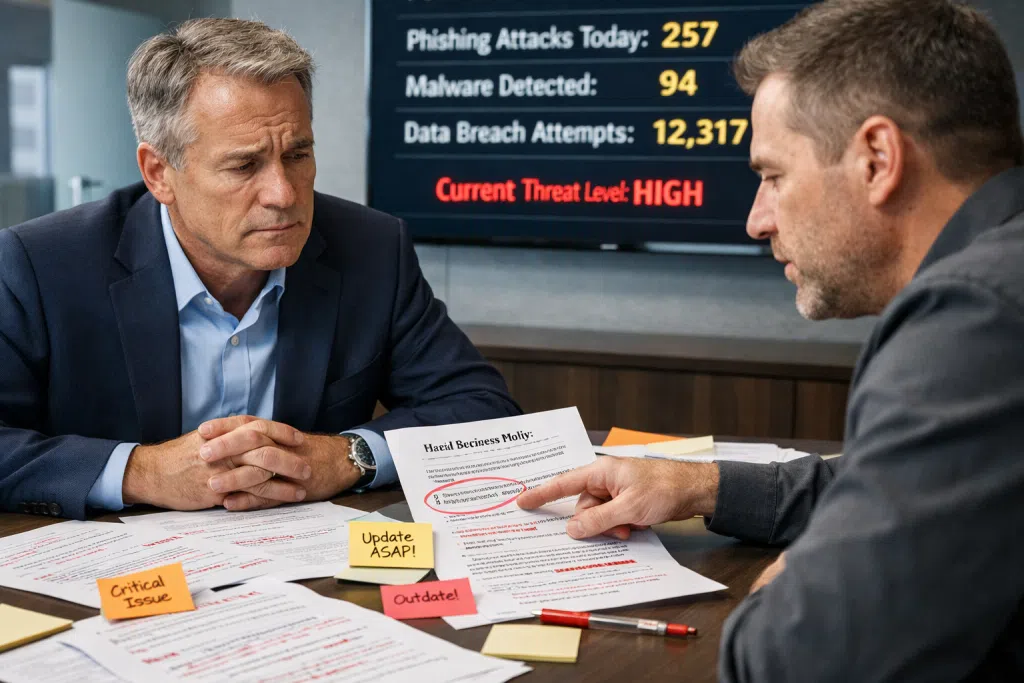
Why an Outdated Email Security Policy Puts Your Business at Risk
Business owners and IT managers face a relentless barrage of email threats. Cyber attackers exploit outdated, incomplete, or unenforced email security policies to breach systems, steal sensitive information, and defraud organizations of all sizes. Despite the evolution of threats, too many companies lean on policies written years ago or patched together hurriedly after an incident. If your email security policy hasn’t been reviewed in the past year, or worse, since the last IT provider change, your business could be exposed to dangers you haven’t anticipated.
Outdated email security opens the door to a wide range of problems. Today’s attackers rely on phishing schemes, socially engineered emails, business email compromise (BEC), malware attachments, and credential theft. Just one successful attack can disrupt operations, think of encrypted files causing downtime, fraudulent wire transfers, or the public exposure of sensitive customer data. According to recent data from Proofpoint’s State of the Phish 2026 report, over 80% of surveyed organizations worldwide experienced email-based phishing attacks last year, with significant financial and reputation damage in their wake.
It is no longer enough to rely on standard spam filters or encourage employees to “be careful with attachments.” Modern email security policy requires a layered approach. Ongoing user awareness training, advanced filtering technologies, clear incident response procedures, and regular policy reviews all work together to reduce risks. This shift is critical for regulated businesses, especially those in healthcare, finance, legal, or any sector bound by HIPAA, PCI-DSS, or similar frameworks. In densely populated and regulated regions like New Jersey, SMBs face local threats tailored to known business practices and technology infrastructure quirks.
So what should trigger a review? Take a close look at recent cyber events in your industry, new compliance rules in your region, and rapid advances in both AI-powered cyber threats and defense solutions. If your policy doesn’t reflect these, it’s already behind.
Connect with Blueclone Networks now for tailored advice on securing your entire organization.
The Critical Components Every Business Email Security Policy Needs in 2026
An effective, modern email security policy is neither generic nor one-size-fits-all; it must reflect your industry, regulatory mandates, workforce structure, and technology platforms. With attack techniques growing in scale and sophistication, the following elements belong in every serious business email security policy.
- Acceptable Use Guidelines: Employees need clear, explicit guidance on what constitutes acceptable use of company email systems. This goes beyond stating “no personal use”, spell out rules for sharing sensitive data, handling attachments, and recognizing suspicious requests.
- User Access Controls and Authentication: According to Verizon’s 2026 Data Breach Investigations Report, compromised credentials are still a leading cause of breaches. Demand unique, complex passwords and enable multi-factor authentication (MFA) for all users, especially those with admin-level access or who handle confidential client information.
- Phishing and Social Engineering Preparedness: Regularly educate staff with real-world simulation exercises. Test responses to simulated phishing, wire fraud, or fake vendor invoices to keep users alert. Embed reporting protocols so staff can flag suspect messages quickly without fear of retribution.
- Advanced Threat Protection: Relying on a basic spam filter is no longer sufficient. Deploy advanced email protection services that use AI to scan links, attachments, and sender behaviors. Look for solutions that detect zero-day threats and stop sophisticated spear-phishing campaigns in their tracks.
- Incident Response Plan: An effective policy cannot just outline prevention; it must provide a playbook for what happens if an attacker slips through, including immediate steps for the affected user, IT response timelines, legal notification requirements, forensic evidence gathering, and external communications.
- Continuous Policy Review and Update: Your email security policy, like your larger cyber safety strategy, should never be static. Revisit guidelines quarterly or after any security incident, IT system change, regulatory update, or new business initiative.
- Regulatory Compliance Alignment: Many SMBs in central NJ and the surrounding areas must align with frameworks like HIPAA, FINRA, or PCI-DSS. Your policy should clearly map how its requirements, encryption, logging, and retention meet those mandates.
To bring the entire program together, management commitment is vital. A policy that exists only on paper, never reinforced or audited, offers little real-world protection.
The Hidden Gaps Exposing Your Email Security (And How Attackers Exploit Them)
Even companies with a “compliant” email security policy are often blindsided by security breaches. Why? Because legacy policies tend to miss certain critical vulnerabilities that cybercriminals actively seek out. Without a regular, thorough review, ideally against a robust framework, businesses leave the door open to attacks crafted to bypass their current controls.
Missed or Weak Multi-Factor Authentication (MFA): Many policies mandate strong passwords but fail to make MFA mandatory for all, especially administrative and remote accounts. Attackers often use password sprays or stolen credentials from old breaches to compromise accounts without resistance.
Outdated Software and Unpatched Mail Gateways: Attackers actively scan for email systems running on outdated or unsupported software. Vulnerabilities in Microsoft Exchange, for example, have been prime targets for ransomware gangs. A modern email security policy should ensure regular patching protocols are written, enforced, and verified.
Lack of Account Segmentation: Companies frequently allow a single compromised account to impact the entire company. By failing to segment access based on roles (sales, finance, IT, etc.), a successful phishing attack has a pathway to lateral movement, allowing hackers to steal data or deploy malware more widely.
Insufficient Employee Training Frequency: Annual “compliance” training misses the reality that phishing tactics evolve month to month. Attackers exploit seasons (tax time, holidays), company events, and current business news. Training should be at least quarterly, with spot tests after known threats or local incidents.
Poor Email Encryption and Data Loss Prevention: Sensitive data in emails without proper encryption, or no automated scanning for confidential info in outgoing emails, leaves regulated businesses out of compliance and puts client trust at risk. Data Loss Prevention (DLP) rules should be explicit, including what to encrypt, when, and how.
Lack of Incident Response Drill: Many policies outline steps to take after incidents, but never rehearse them. If your team has never practiced responding to an incident, the first real breach is sure to reveal confusion and delay.
Attackers are effective because they know where businesses cut corners or postpone updates. Routine audits, including vulnerability scans and simulated attacks, reveal gaps before real criminals do.
For guidance on fortifying your business email security, including technical and policy weaknesses, connect with Blueclone Networks for personalized expertise and practical solutions.
Email Security Best Practices: Updating Policies and Deploying Modern Solutions
Modernizing your email security policy involves more than copying standard language from online templates. It requires a fundamental shift to recognize that attackers actively study policies, system weaknesses, and user habits. Here’s how to build a forward-looking approach that stands up to evolving threats.
Invest in Layered Email Protection Services
A robust defense starts with solutions beyond generic spam filtering. Utilize advanced filtering tools that analyze sender reputation, scan every link and attachment in real time, and use ML-powered threat intelligence to identify new tactics. For secure business email, consider solutions that offer domain impersonation detection and real-time sandboxing of suspicious attachments.
Require Password Management and MFA for All
Single-factor authentication is no longer enough. Industry leaders now suggest integrating password managers (to encourage unique and strong passwords per account) and requiring MFA, especially for executives and employees who access cloud services or manage sensitive files.
Regularly Update Employee Awareness and Simulate Threats
Build an ongoing employee education program into your business email security policy. Use short, targeted phishing simulation tests and provide immediate feedback. Realistic drills prepare employees not only to spot threats but also to follow your policy’s reporting and escalation procedures.
Write Policy for Remote and Hybrid Workforces
Many policies still assume all email use occurs in one corporate office. With hybrid and remote employees, you must account for access on personal devices, in public locations, and across unsecured networks. Align your policy to ensure company data is protected everywhere, and use mobile email security tools to monitor and enforce compliance across devices.
Integrate Automated Threat Response Tools
Speed matters. Automated detection and response tools can isolate infected inboxes, revoke compromised credentials, or initiate password resets far faster than manual response alone. This limits the blast radius of any single breach.
Stay Alert to Regulatory and Industry Changes
New rules, from state privacy laws to federal regulations, regularly change what’s expected for data retention, breach notification, and encryption. In sectors such as healthcare and law, neglecting these updates risks not just fines but client loss and damage to your brand. For regulated New Jersey businesses, frequent policy reviews and clear documentation are vital for both legal safety and client confidence.
For an in-depth guide on business and email security best practices, explore this resource or Connect with Blueclone Networks now to receive a tailored assessment and recommendations.
Common Policy Mistakes That Undermine Business Email Security
Even well-intentioned organizations stumble with implementation or fail to ensure policies are realistic for day-to-day business. The repercussions can be severe, yet most mistakes are preventable once recognized.
Mistake #1: Relying Exclusively on Written Policy Without Enforcement
A PDF emailed to employees during onboarding can’t stop phishing or ransomware. Leadership must enforce policies with ongoing reminders, regular audits, and practical demonstrations. For example, holding brief “what went wrong” case reviews after a real or simulated incident reinforces learning far more than a one-off policy signature.
Mistake #2: Ignoring Unique Risks Posed by Business Email Compromise (BEC)
A written policy might focus on generic phishing but ignore how BEC attacks exploit company hierarchies and financial workflows. A clear, regularly updated policy should require verbal or out-of-band approvals for wire transfers, sensitive document requests, or changes to vendor payment info.
Mistake #3: Not Adapting to New Apps or Collaboration Tools
As teams adopt new platforms, cloud SaaS tools, file sharing apps, and chat integrations, the original policy may leave these endpoints out of scope. An up-to-date email security policy should track the full lifecycle of email and associated collaboration, including how files and data flow between platforms.
Mistake #4: Forgetting to Test the Recovery Process
Policies often mention backups or email archiving but neglect regular, real-world restoration tests. Conduct periodic drills to ensure backups are accessible, complete, and can be restored quickly. This is your lifeline after a ransomware attack or major business interruption.
Mistake #5: Underestimating Third-Party Email Access
Policies commonly overlook contractors, vendors, or business partners with delegated access to email systems. Require vendor risk reviews and ensure external access follows your standards, enforced by secure business email tools and strict onboarding/offboarding processes.
A winning policy is alive, kept current by operational use, tested procedures, and updated for every organizational or technological change. Organizations that succeed treat email security best practices as a process, not a one-time project.
Real-World Examples: The Cost of Poor Email Cyber Security Policy
Examining real incidents delivers vivid insight into the risks businesses face by failing to update their email security policies. Recent breaches demonstrate how deficiencies translate into operational chaos, regulatory scrutiny, and reputational damage.
Case 1: Healthcare Practice Targeted by Phishing, Exposing Patient Data
A multi-office healthcare group in New Jersey saw its operations upended when an employee fell for a realistic phishing email. Lacking multi-factor authentication and a well-drilled response plan, the attackers spent days inside the email system. Sensitive patient records were downloaded and leveraged for blackmail, triggering a HIPAA investigation, financial penalties, and a months-long legal battle to restore trust.
Case 2: Law Firm Loses Client Trust After Wire Fraud
In another New Jersey example, a law firm wired six figures to an overseas account after an email arrived, seemingly from a senior partner. The firm’s email security policy failed to specify out-of-band confirmations for financial transfers. The transfer was irreversible, and the client, seeing a “preventable mistake,” took their business elsewhere.
Case 3: Small Manufacturer Hit by Ransomware From Malicious Email Attachment
A local manufacturing company’s legacy policy did not require security scans for email attachments. An employee opened a disguised executable, introducing ransomware that encrypted file servers and stopped production for three days. Lacking current backups, the company paid part of the ransom and suffered additional costs to recover workflow.
These examples echo the trends highlighted in the CISA Phishing Campaigns Alert (2026), where attackers adapted tactics rapidly across regions and sectors, exploiting gaps in both technical controls and human vigilance.
A modern, regularly reviewed email security policy, aligned with robust email protection services, defends against these losses. Blueclone Networks assists businesses in regulated industries by designing, implementing, and managing secure, practical policies matched to real-world threats and compliance demands.
Building a Culture of Vigilance: Leadership, Accountability, and Continual Learning
A modern email security policy is only as strong as the people who follow it. While technology is a core component, a truly resilient posture requires buy-in from every level of the business, starting with leadership but extending to every employee, contractor, and partner. Leaders must set clear expectations, back policy with resources, and recognize that email security is not just an IT issue; it’s fundamental to business continuity, reputation, and trust.
Accountability must be built into the framework. Assign ownership for policy enforcement and regular policy review, whether to an internal IT manager or an external partner like Blueclone Networks. Create mechanisms for anonymous reporting of suspicious activity and for providing feedback on policy effectiveness. This fosters an environment where employees can confidently report questionable emails without fear of blame or reprisal, resulting in faster incident response and fewer successful attacks.
Regular communication is essential. Schedule policy awareness campaigns, leverage interactive cyber risk workshops, and provide real-time updates about new threats or lessons learned from recent incidents. When business email security is integrated into daily routines and team goals, it shifts from a checkbox exercise to an ongoing commitment.
Cultivating a learning organization is key. Encourage staff to participate in cybersecurity webinars, simulated phishing campaigns, and incident post-mortems. Incentivize safe behavior and reward diligence. The attackers never stop refining their tactics, neither should your defenses.
If you want guidance on fostering a proactive, security-first culture and developing a policy that fits your unique business, connect with Blueclone Networks today for actionable expertise and resources tailored to your industry and operational structure.
Frequently Asked Questions About Email Security Policy
If your policy hasn’t been reviewed in the last 12 months, if your business has grown or shifted to remote/hybrid work, adopted new platforms, or if industry regulations have changed, it’s time for an update. Policies should evolve rapidly to keep up with new attack techniques and company needs.
No single solution delivers total protection. However, combining multi-factor authentication, advanced threat detection, and frequent employee training makes it far harder for attackers to penetrate your systems and spread inside your organization.
Quarterly exercises are recommended, with supplemental tests after major industry-wide attacks or known incidents in your organization. Training must be ongoing to counter ever-changing phishing tactics and social engineering tricks.
Cloud services are a powerful defense but should be one layer of a comprehensive policy, supported by strong user access controls, data loss prevention rules, encryption, and regular testing. Technology and policy together provide the strongest barriers.
If you’ve experienced a recent incident, lack internal expertise, or must align with regulatory frameworks (such as HIPAA, FINRA, or PCI), engaging a professional team like Blueclone Networks can bring both perspective and hands-on help, ensuring your policy matches today’s risks and tomorrow’s regulations.