






Beyond HIPAA Compliant Email: Where Most Organizations Overlook Business Email Security
Healthcare, legal, finance, and pharmaceutical firms face growing scrutiny over protected data, with business email platforms right at the center of regulatory and security concerns. Many assume that adopting a HIPAA compliant email solution addresses every possible risk. Yet as regulatory threats, cybercrime tactics, and data-sharing technologies evolve, relying solely on email compliance tools often leaves organizations exposed to threats few anticipate, especially in sectors handling sensitive personal or legal information. The idea that “secure email” means you’re protected against every vulnerability is no longer enough. SMBs across New Jersey and the Tri-State area are discovering these gaps only after experiencing costly incidents that could have been prevented.
Before today’s communication patterns, a simple email encryption service might have sufficed. Now, attackers exploit weak authentication methods, target busy staff with phishing, and sidestep technical controls by socially engineering passwords over the phone. Recent data shows that almost 90% of breaches in healthcare begin with an email compromise, commonly involving a credential phishing attack. Traditional HIPAA-compliant email services generally help meet minimum requirements, such as storing and transmitting protected health information (PHI) securely. Yet, minimum compliance isn’t synonymous with meaningful protection.
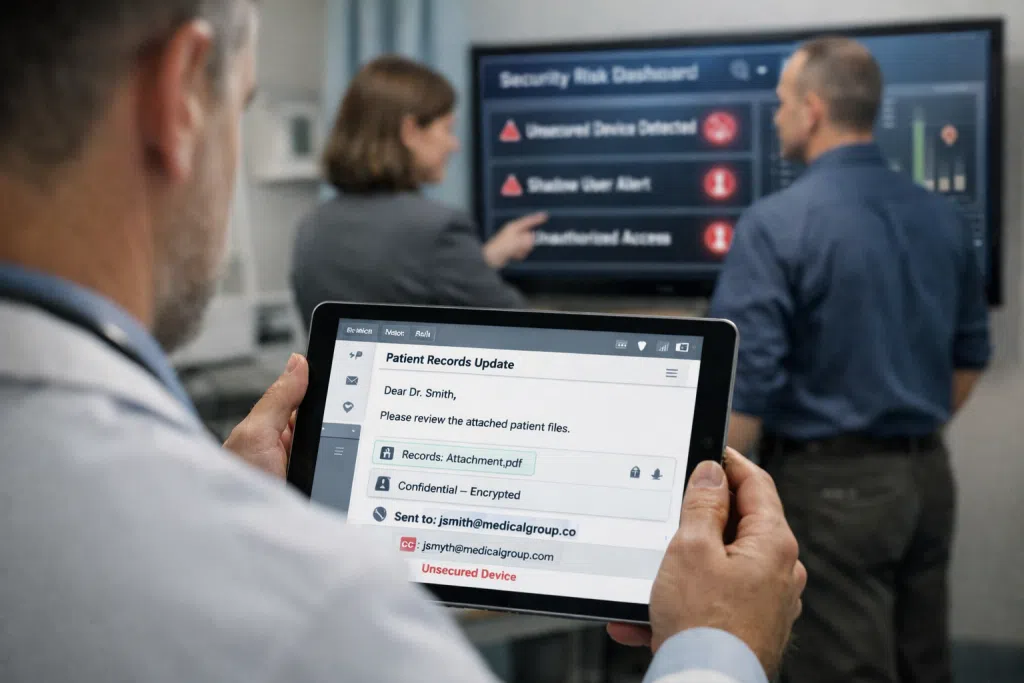
Take the scenario of a Central NJ healthcare clinic. They use an encrypted email platform, ensuring email in transit and at rest remains protected. But one employee, fooled by a lookalike sender address, enters credentials into a fake login page linked from a message that wasn’t actually intercepted by the spam filter. The attacker gains access to hundreds of confidential patient files and sets up email forwarding rules to siphon off new data. Despite every email message being encrypted and every control box ticked on compliance checklists, a devastating breach occurs.
This isn’t an isolated case. Professional service firms in Princeton, attorneys working with confidential client data, and pharmaceutical R&D groups all place immense trust in “compliant” messaging solutions. Too few realize these won’t prevent human error, sophisticated phishing, or zero-day email attacks. SMBs need layered email security policies, advanced authentication, real-time anomaly detection, and continuous user awareness.
Only a holistic email risk management strategy, one that integrates HIPAA compliant email encryption with next-generation business email security, delivers true peace of mind. Organizations in the NJ Metro area looking for this layered defense are turning to dedicated IT partners. Blueclone Networks, operating locally for nearly two decades, brings hands-on support: seamlessly integrating compliance-grade tools with AI-powered detection and 24/7 response.
If your organization still believes HIPAA compliant email alone is sufficient, it’s time for a deeper conversation. Uncover hidden email risks and get tailored guidance on advanced business email security services by booking a session: Connect with Blueclone Networks now.
The Foundation of HIPAA Compliant Email: What Is Required, And Where Minimum Compliance Falls Short
To understand why HIPAA-compliant email falls short as a stand-alone solution, it’s important first to review what “HIPAA compliance” for email actually entails. At its core, HIPAA (the Health Insurance Portability and Accountability Act) compels covered entities and their business associates to safeguard Protected Health Information (PHI) during transmission, storage, and access. This mandates the use of specific security controls for email systems, including:
- End-to-end encryption (in transit and, increasingly, at rest)
- Strong user authentication
- Audit trails for access and email activity
- Data loss prevention (DLP) mechanisms
- Secure, role-based access controls
- Written agreements (BAAs) with service and technology providers
By meeting these baseline requirements, organizations are equipped to demonstrate compliance during audits and reduce legal risk in the event of an incident. Many email service providers now offer “HIPAA compliant email encryption” out of the box, together with a Business Associate Agreement. Standard features typically include TLS encryption, secure storage, and password-protected messages.
Unfortunately, this approach creates a false sense of security. HIPAA-compliant email solutions primarily address static risks, interception of PHI during transmission, unauthorized server access, accidental message delivery, but do not catch evolving attack vectors. Basic encryption does not prevent a user from being fooled into entering their password into a malicious webpage accessed via a phishing email. Most HIPAA email tools use signature or heuristic filters, which recognize common spam and malware, but sophisticated attackers now design payloads that bypass these systems using obfuscated links or pretending to be legitimate business contacts.
Furthermore, while a BAA with your email provider is required, it does not make the business immune to the consequences of a breach. Regulators like the Office for Civil Rights (OCR) frequently levy penalties even on organizations that have technical safeguards in place if lapses occurred due to process gaps or preventable user behavior. It’s worth noting that the recent rise in legal action has shifted focus from adhering to the letter of HIPAA law to “demonstrating good faith” and employing risk management best practices, even those not explicitly required by the law.
A recent study by the Healthcare Information and Management Systems Society (HIMSS) found that only 40% of healthcare organizations regularly review the “real-world” effectiveness of their email security tools. The rest rely solely on their provider’s HIPAA statement and hope for the best. In today’s threat environment, characterized by advanced phishing, business email compromise (BEC) schemes, ransomware payloads, and credential stuffing, hope alone is not a strategy.
Business leaders, IT staff, and compliance officers must ask whether their secure email environment protects not just against compliance failure but against disruption to operations, patient care, and trusted client relationships. Providers across Princeton, Trenton, and the Northeast are increasingly layering specialized email security services on top of their baseline HIPAA compliant email tools to achieve this real-world defense.
Email Security Threats That Outpace Compliance-Only Solutions
While the minimum technical requirements for HIPAA compliant email focus on encryption and secure handling of PHI, today’s threat landscape is shaped by attackers who adapt quickly to the latest safeguards. Cybercriminals and state-sponsored actors now routinely bypass basic protections, exploiting the weakest link: human users and the complex workflows of modern organizations.
Let’s look at several prevalent threats that a compliance-only approach leaves exposed:
Phishing & Social Engineering
Phishing remains the leading cause of email-related breaches. Attackers send authentic-looking messages that prompt staff to disclose credentials, approve wire transfers, or open malicious attachments. According to the 2026 Verizon Data Breach Investigations Report, over 70% of all healthcare breaches began with credential phishing. Standard HIPAA compliant email encryption cannot detect or block cleverly crafted social engineering schemes that pass technical filters but dupe users psychologically.
Business Email Compromise (BEC) & Account Takeover
In BEC, attackers impersonate trusted entities (such as C-suite executives or vendors), requesting sensitive documents or fraudulent transactions. Once a single account is breached, attackers can manipulate email rules to secretly forward or delete messages, harvest confidential data, and move laterally across departments. HIPAA compliance does not mandate multifactor authentication, privileged access management, or real-time monitoring of unusual login activity, all essential defenses against BEC.
Ransomware Delivery via Email
While ransomware is on the rise across all sectors, healthcare and legal organizations are especially lucrative targets. Malicious attachments, macro-laden documents, or links to weaponized websites are sent via email. If a single user opens a bad file, ransomware can spread rapidly across networks. Standard encrypted email does nothing to flag or quarantine these advanced threats, particularly if the payload is undetected by signature-based antivirus engines.
Insider Threats and Accidental Data Loss
Not all email threats are external. Employees might accidentally forward PHI to unauthorized recipients or intentionally exfiltrate data for personal gain. True secure email implementations require data loss prevention (DLP) systems, content filtering, and customizable security policies that block risky sharing, none of which is guaranteed by “off-the-shelf” HIPAA compliance.
Supply Chain & Third-Party Risk
Attacks increasingly enter via business partners or suppliers with weaker controls. If an external CPA or law firm is breached, threat actors can send authentic-looking messages into your environment, leveraging established trust and even valid message signing. Minimum compliant practices rarely require third-party email risk vetting or sender authentication validation like DMARC, DKIM, and SPF records.
Real World Example:
A small Princeton medical billing firm recently suffered a major incident after an employee was tricked by an email from what appeared to be a recognized healthcare partner. The message bypassed basic spam filters and led to unauthorized access to both internal and client systems, despite having HIPAA email encryption in place and a valid BAA. Months of remediation and brand damage followed.
A recent Cisco Secure Email Threat Intelligence Report (2026) highlights a growing trend: attackers craft messages that evade detection by changing language, sender domains, and hiding malicious links in benign-looking attachments. This type of threat requires AI-powered detection, context-aware filtering, and constant user education, all features beyond typical HIPAA email compliance.
Connect with Blueclone Networks now to learn how advanced email security services bolster your current HIPAA compliant email and reduce real-world business risk.
Building a Layered Approach: Key Features of Holistic Email Security Solutions
Given the evolving tactics and regulatory space, organizations need more than just compliant email. Achieving true business email security involves integrating multiple complementary layers, from technical controls to ongoing user training. Here are the pillars of a comprehensive solution:
Advanced Threat Protection (ATP) & AI-Powered Filtering
Modern ATP platforms use behavioral analytics, machine learning, and threat intelligence feeds to detect threats that standard filters miss. These systems analyze header information, sender reputation, writing style, attachments, and URLs in real-time. Zero-day threats and highly targeted phishing attempts are flagged even if the indicators haven’t been previously cataloged. Email security services that include AI detection are now essential for NJ’s regulated industries.
Multifactor Authentication (MFA) & User Identity Controls
Enforcing MFA for email systems, especially for accounts handling PHI or legal data, reduces the risk of credential theft. Effective business email security tools layer MFA with conditional access policies (e.g., device fingerprinting, geofencing) to prevent unauthorized logins and identify suspicious patterns.
Data Loss Prevention (DLP) & Content Filtering
Advanced DLP tools monitor outbound email content, automatically flagging or stopping messages containing confidential client, legal, or patient data that aren’t being sent according to policy. These services ensure inadvertent or malicious external sharing is identified and blocked early.
Encryption That Goes Beyond the Basics
True secure email for HIPAA and other regulatory frameworks means persistent message-level encryption, not just transit encryption. Some systems allow senders to recall sent messages or set expiration policies, adding another safeguard if an error is made.
Email Archiving With Real-Time Auditing
Complete email archiving ensures every message (inbound, outbound, and internal) is stored securely, indexed, and easily retrievable during an audit, investigation, or litigation process. Fast search capabilities and immutable logs help organizations comply with regulatory inquiries and demonstrate reasonable risk management practices.
User Awareness and Real-World Testing
Human error remains the root of most email breaches. Regular phishing simulations, targeted training modules, and real-time coaching can shift your least tech-savvy team member into your best security asset. According to Microsoft’s 2026 Digital Defense Report, organizations that conduct monthly simulated phishing exercises reduce real incident rates by over 60%.
Incident Response and Managed Monitoring
Even the strongest controls can sometimes be breached. Leading providers of email security tools include rapid incident response, forensics, and managed threat monitoring. Having an expert partner who knows your business and understands local and industry regulations is a critical factor in minimizing both downtime and regulatory penalties after an incident.
Secure Integration With Collaboration Tools
Email does not exist in isolation. The rise of AI cloud services, secure file sharing, and collaboration platforms (like Microsoft 365, Google Workspace, and industry-specific document management tools) increases the risk of lateral movement once an email account is compromised. Seamless integration of email security across all platforms is a must.
Firms in Central New Jersey need layered business email security services tailored to the real challenges they face. Blueclone Networks helps healthcare, legal, finance, and pharmaceutical companies implement such layered strategies, combining HIPAA-compliant email encryption with holistic protection that adapts to new threats.
Compliance, Liability, and the Real Cost of an Email Breach
Regulatory compliance is not a one-off certificate you can obtain and forget. Regulatory penalties for breaches, especially those involving PHI, continue to intensify, but the financial impact rarely ends with initial fines. According to the U.S. Department of Health & Human Services (HHS) 2026 breach summary, reported healthcare email breaches led to settlements ranging from tens of thousands to several million dollars, depending on whether reasonable risk management practices were in place.
When legal, finance, or healthcare SMBs fail to go beyond bare minimum HIPAA-compliant email protections, they face major downstream consequences:
- Direct financial penalties from OCR and other regulators for failing to employ “reasonable and appropriate safeguards,” even if basic encryption is used.
- Class action lawsuits from patients, clients, or business partners whose data was exposed, especially if user error or simple attacks could have been prevented with readily available security tools.
- Loss of business reputation and client trust, which for small local practices can be existential. Healthcare providers in NJ see patient churn soar after data disclosure events, regardless of whether the incident involved malicious intent.
- Operational downtime while teams remediate breaches, investigate, and rebuild affected systems, halting revenue and damaging critical business relationships.
- Mandatory notification and corrective action plans, which must be submitted and verified over time, add to the compliance and legal burden.
Research published by Ponemon Institute in their 2026 Cost of a Data Breach Report shows that average recovery costs now exceed $420 per compromised record in healthcare, including hidden costs such as monitoring services for affected individuals, forensic analysis, and increased cyber insurance premiums.
The most painful liability often comes not from regulators, but from a lack of preparedness exhibited in audits and post-incident reviews. “We had HIPAA compliant email” does not absolve firms of their duty to demonstrate proactive risk assessment and ongoing security program adjustment.
For organizations with complex workflows, like clinics working with external law firms, medical research bodies sharing data with pharmaceutical partners, or finance offices coordinating with nationwide insurers, the risks climb exponentially without comprehensive, up-to-date email security services.
Organizations seeking to protect against both regulatory and existential business risk are working with partners like Blueclone Networks, whose team builds robust defense-in-depth strategies combining policy, people, and technology.
If you’re ready to strengthen your email defenses past simple compliance and protect your entire practice, client base, and business future, connect with Blueclone Networks today.
Choosing the Right Email Security Services For Regulated SMBs in NJ
With so many email security vendors and products in the market, SMBs in regulated industries need a trusted process for evaluating what will actually meet their business, compliance, and operational needs. Here’s a practical checklist to guide leadership and IT decision-makers in selecting the right fit beyond HIPAA compliant email:
Strategic Questions to Ask:
- Does the platform offer layered security, including AI-powered threat detection, DLP, and persistent encryption?
- Can the solution integrate seamlessly with your electronic medical records (EMR), legal document portals, or financial workflow software?
- Is multifactor authentication (MFA) required for all users, especially those working with PHI or confidential data?
- Are there robust audit and reporting features in place to support both real-time monitoring and historical reviews?
- How often are user-awareness trainings and phishing simulations provided? Is there ongoing support rather than simple one-off workshops?
- What is the process for responding to incidents? Are there local, trusted experts available 24/7, not just automated systems?
Business and Compliance Alignment:
- Does your provider actually sign a Business Associate Agreement, with clear accountability and support during audits or investigations?
- Is the vendor transparent about the security architecture, data residency, and ongoing monitoring procedures?
- Does the security solution accommodate state-specific regulations in addition to HIPAA (such as the New Jersey Data Breach Notification Law, or sector-specific requirements for finance and legal)?
- Are the tools scalable, allowing for BYOD (Bring Your Own Device) across remote/hybrid teams, and covering all endpoints, email, mobile, and cloud services?
- Can your in-house IT or co-managed IT team customize access and security policies easily from a single dashboard?
Local and Industry Expertise:
For SMBs in Princeton, Trenton, and the Greater New Jersey area, local support and in-person responsiveness can be critical. Working with a regional provider who understands both state and federal regulations, as well as the unique day-to-day workflows of healthcare, legal, and finance professionals, provides a distinct edge. Blueclone Networks, headquartered in Princeton, has advised and protected SMBs in regulated sectors for nearly 20 years, ensuring compliance is just the starting point for real security.
Below is a sample comparative table of key features that regulated SMBs should examine when evaluating email security options:
For small clinics, law firms, financial advisors, and pharmaceutical teams, the right approach is to partner with a provider that treats security as a living, evolving program, not a checkbox.
Looking to upgrade your business email security or need hands-on help evaluating providers? Connect with Blueclone Networks now.
FAQ: HIPAA Compliant Email, Security, and Practical Management
HIPAA compliant email ensures the baseline technical requirements (encryption, secure storage, audit trails) are met per federal law. Advanced business email security layers in threat detection, user-awareness training, data loss prevention, multifactor authentication, and incident response, providing real-world protection against today’s evolving threats, well beyond minimum compliance.
Yes. HIPAA compliance only mandates encryption and basic access controls. Most breaches today stem from phishing attacks, which fool users, not technical systems. True protection requires ongoing simulated phishing tests, continuous user education, and AI-powered detection to flag malicious links or impersonation attempts that traditional filters miss.
Absolutely. New Jersey’s Data Breach Notification Law, for example, imposes strict reporting and risk management requirements, in addition to HIPAA or federal rules. Firms in regulated fields must ensure that security tools account for both federal and local mandates and that breach response plans are updated for state laws.
Email Data Loss Prevention (DLP) automatically scans outbound messages for sensitive keywords, file types, or data patterns (like social security or patient numbers). If a high-risk message is sent in error, even if encrypted, DLP can stop or quarantine it before it leaves your system. This is critical for preventing both unintentional and insider-driven data leaks.
Reputable providers of HIPAA compliant email will proactively offer a BAA as part of their onboarding process. However, it’s essential to review the terms to ensure they cover breach response, liability, and ongoing support. Don’t assume a BAA means the provider takes full legal responsibility for security lapses; shared responsibility is still the norm, so robust internal controls are always required.