






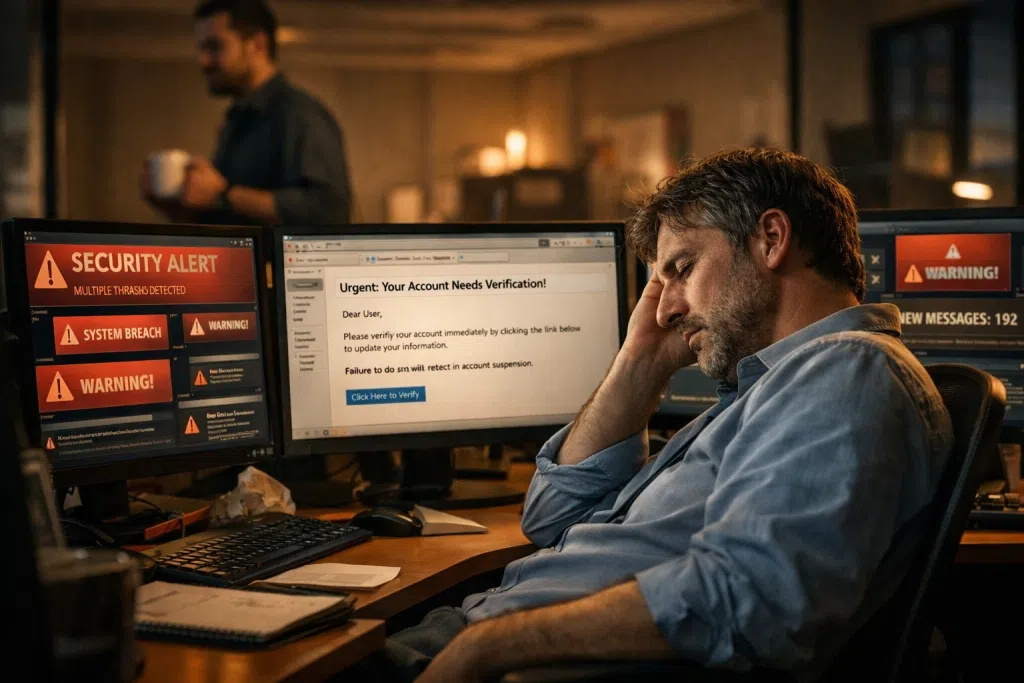
The Limits of Technology: Why Human Error Still Undermines Email Cyber Security
For healthcare practices, legal offices, financial services firms, and other regulated small to mid-sized businesses, email remains both a workhorse and an Achilles heel. Many organizations prioritize robust technology to block cyber threats, with layered filters, threat intelligence, and advanced secure email features. Still, the persistent reality is that human error, despite all this investment, remains the dominant cause of breaches involving business email security. As email cyber security measures become more advanced, attackers have simply shifted their tactics, exploiting subtle gaps in processes and natural lapses in user attention.
Understanding the unique fatigue that accompanies constant vigilance in regulated professions can help organizations recalibrate security training and process design. Email, by nature, is a trusted and integral tool. Employees, tasked with critical business activities, naturally trust messages from colleagues, clients, and vendors. Yet, this trust comes under fire each time a phishing attempt is successful because someone clicks a convincingly crafted link or surrenders login credentials to a fake email security check.
Much of the challenge lies in the sheer volume and sophistication of threats. According to a 2026 study conducted by the Anti-Phishing Working Group, business email compromise losses exceeded $2.7 billion, outpacing other digital crime categories. The overwhelming wave of targeted phishing attacks, credential theft attempts, and impersonation schemes mean defenses are never foolproof. There’s a growing sense among end-users that despite rounds of security awareness training, technical defenses, and company reminders, “something is bound to slip through.”
For regulated industries in Central New Jersey and the surrounding region, these risks carry heightened consequences. Compliance frameworks like HIPAA, PCI-DSS, and FINRA all require not only secure email but also robust documentation and incident response. No matter how capable a technical stack your organization invests in, employees remain the final, and most vulnerable, line of defense.
Security fatigue is not just about tiredness; it’s the psychological consequence of cumulative threats and constant caution. Employees can become desensitized, ignoring real warning signs or feeling overwhelmed by the sheer volume of alerts. Curiously, the more advanced the technology becomes, the more the average person feels isolated from the threat, leaving a dangerous gap for criminals to exploit.
For organizations navigating this balance, actionable strategies make a difference. Automating the most tedious aspects of phishing detection, providing real-time warning systems, and developing routines for email protection services, like regular simulated phishing campaigns, can cut through the fatigue. But bridging the gap between policy and practice always requires a measured blend of technology and ongoing, empathetic user education.
If your firm is grappling with email fatigue, specialized support matters. Connect with Blueclone Networks now to assess your business risk and build a practical, people-centered plan.
From Perimeter Defense to Inbox Vigilance: Evolving Email Threats and Modern Tactics
As cyber criminals adapt, so too must business leaders and IT teams. No longer do attackers rely solely on obvious spam or known malware payloads. Instead, the modern threat landscape has shifted toward social engineering, personalized spear-phishing, and business email compromise tactics that target specific users by role or industry.
For example, in legal and healthcare environments, attackers often impersonate trusted vendors or manipulate email threads that use confidential information from recent projects. A 2026 Verizon Data Breach Report underscores this trend, noting that over 50% of successful phishing attacks now depend on “thread hijacking” or using real message content to exploit trust within regulated firms.
Machine learning-based secure email gateways and cloud-delivered advanced threat protection have certainly raised the baseline for email security. However, even the most advanced filters cannot detect every cleverly disguised fraudulent invoice or time-sensitive message that appears to come from an executive.
Attackers have also embraced multi-channel strategies, combining email with text messages or voice calls to reinforce their scams. For Central NJ-based businesses serving finance, medical, and legal clients, this means that threat actors will stop at nothing to get what they want, whether that’s sensitive data, fraudulent payments, or a simple password reset. Even routine requests like updating wire transfer details or granting access to cloud documents now demand heightened scrutiny.
But technology can’t be relied upon alone. Take the example of a midsize NJ-based CPA firm that successfully blocks 98% of phishing emails through a next-generation filtering system. Recently, the only incident that bypassed defenses was a single spear phishing email sent on payroll day, tailored with accurate staff information harvested from LinkedIn. One distracted employee clicked, and the business incurred costly recovery and incident response expenses.
What does this teach us? In the age of AI-driven threats, investing in continuous training, real-time incident response, and testing employees under authentic, challenging scenarios is as critical as the underlying email security tools themselves. If you don’t combine cybersecurity awareness with business workflows, even the best technical solutions can fall short.
Building a layered approach involves:
- Regular simulated phishing campaigns
- Behavioral monitoring and AI anomaly detection
- Employee feedback on security procedures
- Rapid reporting channels for suspicious activity
To get a practical, locally relevant perspective on improving your business email security posture, consider a guided consultation. Connect with Blueclone Networks now for a hands-on assessment and best-in-class protection.
The Truth About Phishing Attacks: Why People Still Click (and What Works)
Phishing remains among the most effective forms of cyberattack simply because the tactics continue to evolve, always seeking out the weak spot in human decision-making. Despite widespread awareness, Verizon’s 2026 DBIR confirms that roughly 36% of all data breaches still involve phishing, with median detection times clocking in at multiple days after initial compromise.
What’s driving this continued vulnerability? For employees working in busy, compliance-driven industries like healthcare and finance, cognitive overload is real. Between regulatory documentation, serving clients, and responding to time-sensitive emails, users can become less discerning. Attackers use emotional appeals (“urgent payment required”), social manipulation (“your account will be suspended”), or even mirror legitimate business operations by referencing ongoing contracts or patient referrals.
Modern attackers scour social media, public records, and even compromised email threads to increase the believability of their messages. Increasingly, business email compromise schemes target finance teams, executives, and even IT administrators, imitating real contacts and legitimate dialogue. Phishing attacks today often bypass traditional spam folders and arrive directly in the primary inbox using “lookalike” domains or previously compromised accounts.
No two organizations will experience phishing in the same way. For instance, a Princeton-based healthcare cooperative with strict HIPAA requirements may be exposed through clinical staff accounts, while a Trenton law firm might see attackers impersonate high-value clients or leverage sensitive case information.
So, what actually works? Varying your approach to user education proves more successful than generic, one-time training. Consider:
- Creating phishing simulations that mimic your real business operations and workflow
- Sharing anonymized examples of actual phishing attempts that reached your firm
- Implementing “pause and verify” procedures for all high-value transactions or data requests
On the technical side, deploying layered email protection services can catch many threats before they hit users. Still, employees should be coached not just to spot potential threats, but to feel empowered to escalate when something feels off. Routine, small practice exercises can be more effective than annual seminars.
SMBs in regulated sectors frequently discover that the right combination of technical filtering, real-world simulation, and transparent reporting channels is the only way to move the needle on risky employee behaviors. Business email security is not just a technology problem; it’s a culture of caution and ongoing improvement.
Data supports this: According to CISA’s April 2026 warning, 92% of ransomware infections now begin with a single user clicking a malicious link. Clearly, the challenge is not a lack of awareness, but sustained, relevant intervention tuned to real human workflows.
Email Security Check: Beyond Technology to Cultural Change
A thorough email security check is broader than just scanning for malicious content or updating filter rules. Lasting email cybersecurity starts with people and policy. Here’s a framework organizations can adopt to turn technology investment into meaningful day-to-day security:
Assess Real-World User Behavior:
Analyzing past incidents can provide insights beyond technical scan results. How did attackers bypass existing controls? Which staff roles are targeted most often? Map actual workflow scenarios rather than generic risk lists.
Embed Email Security in Everyday Routines:
Technical controls should meld with routine business processes. For example, implementing mandatory out-of-band confirmations for payment requests can prevent wire fraud, while scheduled, non-punitive phishing tests keep vigilance high without shaming employees for honest mistakes.
Align Policy with Realistic Workflows:
Policies should not force users to choose between business productivity and business email security. Make it easy to report suspicious emails and avoid punitive attitudes around honest mistakes; focus instead on fast response and real-world improvement.
Foster Open Communication:
Creating a culture where users are comfortable raising concerns, without fear of retribution, improves both incident response and system learning. Staff should know whom to contact and what information to share, and IT leaders should provide rapid feedback.
Continuous Vendor Review:
Choose email protection services that match the region and sector, and work with vendors who understand compliance demands. For regulated New Jersey SMBs, a provider like Blueclone Networks brings not just technical expertise, but also a deep understanding of local regulatory pressure and workflow realities.
Simply layering filters on legacy infrastructure is no longer enough. Taking a systematic approach that treats security as a living, human challenge keeps your organization ready for new threats. And with staff engagement high, the power of every technical control increases exponentially.
Embracing AI and Automation in Business Email Security
Automation and artificial intelligence now play a vital role in augmenting human vigilance. AI-driven analysis can cut down response times and turn millions of data points into fast, actionable insights for administrators and users alike.
Next-generation secure email solutions use cloud-based machine learning to identify subtle signs of emerging phishing attacks, identify compromised supplier accounts, and block business email compromise attempts before users ever see them. AI-powered anomaly detection monitors typical communication patterns and flags incongruities invisible to traditional filters.
For regulated industries, AI-based email protection services provide adaptive filtering, real-time warning banners, and context-aware message scoring. A law firm might, for example, see an alert pop up directly in Outlook if a message appears to request confidential client records from a previously unseen address, referencing a closed case file.
Cloud-based security platforms centralize updates, which means that new threats detected by healthcare or finance clients are instantly used to protect others in the network. This reduces the burden on in-house IT teams (especially important for firms with limited technical resources), ensuring business email security stays both current and contextually tuned to local risks.
But it’s not just about technology. Blueclone Networks emphasizes automated incident response and real-world simulation as part of their managed security services. For example, their services can combine advanced AI with scheduled simulated phishing, policy reinforcement, targeted staff training, and responsive live support, all tuned to the real environment of an NJ-based law office or healthcare firm.
When balanced with regular review and user engagement, automation provides fresh eyes and faster response, minimizing lag time between threat detection and coordinated action. Find a partner who blends automation with localized support and regulatory expertise.
For SMBs balancing resource constraints with escalating regulatory and cyber risks, this combination of AI monitoring and empathetic, actionable support is fast becoming the standard for effective email security.
Interested in exploring AI-powered email protection tailored for your industry and region? Connect with Blueclone Networks now and begin the conversation.
Case Study Insights: Human Factors in Secure Email for Regulated SMBs
To understand the stakes involved, let’s look at actual business scenarios faced by Central NJ SMBs in law, healthcare, and financial services. Each shares a common thread: despite investments in technical protection and process improvement, human behavior remains at the center of every incident, both failures and successes.
Scenario 1: Healthcare, Credential Harvesting Attack
A medical billing coordinator at a mid-size Princeton practice received an urgent email seemingly from their EHR vendor, requesting an immediate login to address compliance issues. The email bypassed initial security checks due to its accurate branding and domain typo. The staff member, rushing to meet a documentation deadline, logged in and unknowingly provided credentials. The attack was discovered hours later, when the IT team noticed a large volume of outbound emails. Despite regular training, the staff member admitted to clicking “on autopilot, a classic sign of cybersecurity fatigue.
Mitigation included:
- Resetting all compromised credentials
- Launching a targeted re-education effort focused on common vendor impersonation
- Implementing a stricter email security check process for all vendor communications
Scenario 2: Legal, Business Email Compromise
A managing partner at a Trenton law firm received a routine-looking request to approve a wire transfer. The attacker had compromised the email of their accountant and inserted a lookalike reply in an existing thread. The attack was only discovered during a routine reconciliation, underscoring that no email protection services are foolproof if human confirmation procedures lag behind process automation.
Mitigation steps:
- Establishing two-factor confirmation for all financial requests
- Increasing training frequency specific to financial staff and partners
- Linking secure email alerts to staff mobile devices for real-time response
Scenario 3: Finance, Persistent Phishing Campaign
A small investment advisory firm faced repeated phishing attacks over several weeks. Each attempt used increasingly sophisticated tactics, from spoofed client domains to AI-generated content. Security filters adapted, but one attack succeeded when a staff member mistook a fake quarterly report for a real client request.
Defensive adjustments:
- Integrating behavioral analytics into email review
- Debrief all staff on specific tactics used against their organization
- Scheduling quarterly, firm-specific phishing practice and reward-based vigilance efforts
In each example, solutions that mixed process, policy, and people-first training delivered the fastest improvements. The lesson is clear: lasting business email security requires a deliberate focus on human factors as much as technical sophistication.
FAQ: Addressing Email Cyber Security for Regulated SMBs
Email cyber security fatigue refers to the desensitization or overwhelm that users experience when constantly confronted with cyber threats and security alerts. Over time, staff might ignore or accidentally overlook real warning signs, increasing the probability that human error will open the door to phishing or compromise, despite existing defenses.
Yes. Modern phishing attempts often use publicly available information, email thread hijacking, AI-generated content, and spoofed domains to closely mimic real business communications. These personalized and timely attacks significantly outpace traditional spam, making them harder for both users and basic filters to detect.
Combining advanced email protection services with ongoing, role-specific education is key. Instituting clear reporting procedures, real-world phishing simulations, and mandatory pauses for high-risk transactions all reduce the risk that a threat will slip through human or technical defenses.
Modern business email security platforms offer policy-driven filters, real-time logging, and customizable reporting that help organizations meet industry-specific compliance requirements. They monitor data movement, automate record-keeping, and provide audit-ready logs for regulators, all while shielding sensitive data from attacks.
Work with a provider experienced in regulated industries and local risks, such as Blueclone Networks. Adopt a balanced strategy: use AI-based automation to handle routine defense and reporting, while focusing resources on continuous, supportive staff training. Regularly review processes to ensure they reflect new threats and evolving workflows.