






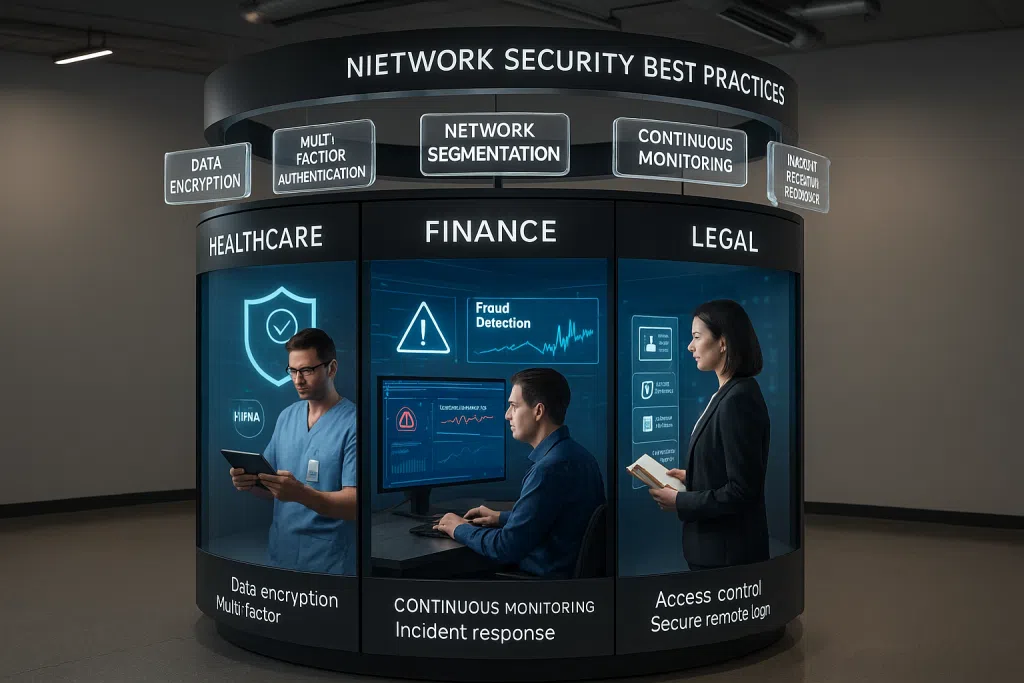
Understanding the Fundamentals of Network Security Best Practices
Network security best practices act as the first and last line of defense for small and mid-sized businesses (SMBs) operating in compliance-driven sectors. When handling sensitive information in healthcare, finance, legal, or pharmaceutical fields, the consequences of a security misstep extend beyond financial penalties. Reputational damage, regulatory action, and operational downtime can result from a single overlooked vulnerability. This reality makes understanding and applying the fundamentals of network security a requirement, not an option.
At the heart of network security best practices are strategies and controls designed to keep data safe from unauthorized access, alteration, or loss. For regulated industries, requirements extend beyond technical configurations. Cybersecurity compliance is integral, aligning technology with HIPAA, PCI-DSS, FINRA, or other standards, while ensuring continuous operations during audits or incidents.
A strong network security posture relies on several foundational areas:
- Access Controls and Authentication: Grant access to data and network resources strictly on a need-to-know basis, using robust identity management, role-based access controls, and multi-factor authentication (MFA).
- Firewalls and Segmentation: Deploy firewalls to create security boundaries, monitor incoming and outgoing traffic, and prevent lateral movement of threats inside the network. Network segmentation helps isolate sensitive segments such as finance records or ePHI (electronic Protected Health Information).
- Patch and Vulnerability Management: Regular updates and timely remediation of known vulnerabilities reduce risk from exploit-based attacks.
- Encryption: Encrypt data both in transit and at rest, protecting sensitive information across endpoints and cloud services.
- Monitoring and Alerts: Utilize security information and event management (SIEM) to monitor traffic patterns, log user behavior, and alert on anomalies indicative of threats.
For legal and healthcare firms based in Central NJ or metropolitan hubs, following proven network security best practices reduces risks and shows commitment to clients and regulators alike. It’s more than technology; it’s a statement of trust and diligence.
Modern SMBs should also recognize that achieving effective security is an evolving process. New regulations, such as updates from the New Jersey Division of Consumer Affairs or recent HIPAA amendments, frequently require policy review and technical adaptation. Failure to align your standards with regulations and evolving cyber threats exposes your business to unnecessary risks.
Before proceeding further into detailed technical and regulatory checklists, consider scheduling a personalized assessment tailored to your organization’s needs. Book an initial Discovery meeting with Blueclone Networks to discuss your unique challenges and compliance goals: Book Now.
Aligning Network Security with Cybersecurity Compliance Requirements
A robust set of network security controls means little if not mapped to formal cybersecurity compliance frameworks. For SMBs in New Jersey and the greater Northeast corridor, regulations such as HIPAA (for healthcare), PCI-DSS (for payment card processing), and FINRA (for financial institutions) are not abstract concepts, they are operational necessities.
Each standard brings a distinct focus:
- HIPAA: Governs safeguards for patient health information, including access, audit trails, and breach notification.
- PCI-DSS: Sets specifics for handling cardholder data, with requirements for encryption, audit logging, and segmentation.
- FINRA: Imposes information security policies for brokers and investment advisors, emphasizing recordkeeping, cybersecurity training, and incident response.
Cybersecurity compliance means harmonizing IT controls with an ongoing process of audits, risk assessments, and continuous improvement. Legal and professional service providers must adopt a living compliance mindset, not just a checklist completed once a year.
According to a 2025 study by Verizon’s Data Breach Investigations Report (DBIR), the rate of confirmed breaches among SMBs rose steeply in regulated sectors, with human factor incidents, like phishing and credential theft, playing a major role in initial compromise. These findings underscore the importance of embedding network security best practices into broader risk management frameworks:
- Regular Audit Cycles: Schedule internal and external audits using a cybersecurity compliance checklist tailored for your specific regulation. Document changes and control validations.
- Policy Development: Maintain clear, enforceable policies for access control, device use, and information handling; review and update at least annually.
- Employee Training: Mandatory annual security awareness and phishing simulations to reduce the risk of social engineering attacks.
- Incident Response: Develop and test a breach notification and escalation process aligned to regulatory expectations.
Regional service providers, such as Blueclone Networks, frequently encounter gaps around multi-cloud adoption, legacy systems, and third-party integrations. For example, many healthcare SMBs fail to maintain encrypted backups in accordance with HIPAA or do not enforce secure access for remote workers.
Embedding compliance into network security strategy not only clears the path for successful audits but also builds client trust and resilience. To keep pace with changing regulations and threats, an experienced partner can help you maintain your cybersecurity compliance checklist and adapt network security best practices in real-time.
Building a Data Security Checklist: Practical Steps for SMBs
Formulating a practical data security checklist empowers SMBs to maintain a holistic view of network risk and regulatory coverage. Safeguarding sensitive personal, financial, or health data requires moving from intentions to systematic controls, reinforced by vigilant monitoring and real-world testing.
A detailed data security checklist typically covers the following categories:
1. Physical and Environmental Controls
- Restrict access to server rooms and data centers to authorized staff.
- Implement alarms, surveillance, and visitor logs for onsite security.
- Ensure environmental controls (temperature, humidity, fire suppression) are tested and maintained.
2. Device and Endpoint Security
- Enforce policies for strong passwords and secure configurations.
- Deploy mobile device management (MDM) tools to track, update, and remotely wipe lost or unused endpoints.
- Schedule regular vulnerability scans on laptops, workstations, and networked devices.
3. Network Security Controls
- Ensure firewalls are properly configured, actively monitored, and regularly updated.
- Use network segmentation to isolate critical data stores from the broader business network.
- Implement intrusion detection/prevention systems (IDS/IPS) to identify suspicious activity.
4. Access and Authentication
- Use multi-factor authentication for all remote access and administrative accounts.
- Apply the principle of least privilege, and grant employees only the access they absolutely need.
- Enforce automated timeout and session lock on systems with sensitive data.
5. Data Encryption and Backup
- Encrypt sensitive data both at rest (on disk) and in transit (via VPN or TLS).
- Maintain fully tested, encrypted backups, stored securely offsite or in a compliant cloud environment like those certified for healthcare or finance.
6. Monitoring, Logging, and Alerts
- Configure centralized logging of access and security events.
- Set threshold alerts for unusual access patterns, failed logins, or changes to sensitive files.
7. Policy Documentation and Review
- Regularly review and update acceptable use, device management, and disaster recovery plans.
- Document procedures for software installation, access requests, and data disposal.
Bringing together these elements forms a routine, actionable data security checklist tailored for healthcare, finance, and legal SMBs. For firms already operating in AI or cloud-centric environments, enhance this checklist with advanced monitoring on AI platforms and additional vendor security due diligence.
A strong data security checklist, combined with an information security checklist and a thorough regulatory compliance checklist, creates a culture of ongoing vigilance. Not only does it prepare your team for external audits, but it also shields your business from evolving threats and day-to-day mishaps.
Interested in reviewing your data security or compliance program? Book an initial Discovery meeting with Blueclone Networks to receive a personalized audit of your digital footprint and compliance posture: Book Now.
Regulatory Compliance Checklist: What SMBs Cannot Overlook
For SMBs in regulated industries, a regulatory compliance checklist is not optional, it’s the backbone of IT risk management. These checklists help organizations track and demonstrate conformity to core standards, ensuring preparedness for regulatory inspections, client audits, or insurance renewals.
Below is a sample regulatory compliance checklist relevant to healthcare, finance, and legal firms in New Jersey:
1. Identify Applicable Regulations
- Confirm which laws apply (HIPAA, HITECH, PCI-DSS, GLBA, FINRA, NJ-specific data protection rules).
- Assign an internal compliance officer to maintain updated awareness.
2. Documentation and Recordkeeping
- Maintain written policies for all IT, physical, and personnel controls.
- Log all access and security events, retain audit logs per regulation (e.g., HIPAA = 6 years).
3. Workforce Education
- Conduct annual compliance training and phishing tests.
- Keep dated records of completed training modules for each employee.
4. Risk Assessments and Audits
- Perform risk analyses at least once a year or when infrastructure changes.
- Document remediation actions and periodic progress reviews.
5. Access Management and Authentication
- Review access to patient or financial records every 90 days.
- Disable access for terminated or transitioned staff immediately.
6. Incident Response and Breach Notification
- Create a response plan and test it with tabletop exercises.
- Outline notification requirements and reporting timelines.
7. Third-Party Vendor Management
- Review Service Level Agreements (SLAs) for cloud vendors and consultants.
- Ensure all vendors handling data sign Business Associate Agreements (BAAs) or appropriate contracts.
Missed items, such as untracked cloud services or incomplete training logs, frequently expose SMBs to fines or operational shutdowns, especially during surprise compliance spot-checks. Effective tools and expert guidance can automate tracking, deliver reminders, and streamline reporting processes.
According to Gartner’s 2025 security and risk management predictions, automated compliance management is now a top initiative for SMBs due to rising complexity across cloud, AI, and third-party integrations.
By regularly revisiting your regulatory compliance checklist, your organization remains audit-ready and able to demonstrate continuous improvement, a critical value for clients, insurers, and board members alike.
Comprehensive Information Security Checklist for Ongoing Protection
An information security checklist spans technical, procedural, and human factors, aligning daily operations with business objectives and external expectations. Small to mid-sized businesses should treat information security as an integrated system that protects digital, paper, and verbal information assets across workflows.
Key Elements of a Comprehensive Information Security Checklist
Asset Inventory and Classification
- Inventory all hardware, software, cloud platforms, and data flows.
- Classify data based on sensitivity and regulatory requirements.
Access Life Cycle Management
- Review user accounts, permissions, and group memberships monthly.
- Formalize onboarding and offboarding with access approval processes.
Network and Perimeter Defenses
- Patch and update routers, firewalls, and VPNs.
- Regularly test external and internal systems with vulnerability scans.
Security Awareness and Insider Threat Detection
- Run simulated phishing campaigns quarterly.
- Enable anonymous reporting for suspicious activity.
Incident Detection and Response
- Install Endpoint Detection and Response (EDR) on all devices.
- Maintain a record of all incidents, near misses, and changes in controls.
Third-Party and Supply Chain Risk
- Conduct due diligence vetting before onboarding suppliers or cloud apps.
- Require contractually mandated cybersecurity practices from partners.
Disaster Recovery and Business Continuity
- Test recovery from backups at least annually.
- Update and review disaster recovery plans after major business or technology changes.
Legal and Regulatory Change Management
- Subscribe to updates from key regulatory bodies such as the New Jersey Department of Health (for HIPAA) or FINRA alerts.
- Track all changes and required actions in an auditable format.
Building and maintaining an information security checklist is a living process. Schedule routine reviews and involve multidisciplinary teams to foster organization-wide engagement, and not just silo IT’s role in security.
One of the most crucial aspects for SMBs is translating this checklist into true operational resilience. That means ensuring plans are realistic, staff are prepared to follow them, and incident rehearsals are actually undertaken. Partners like Blueclone Networks leverage both industry-validated frameworks and regional knowledge to help clients in New Jersey and beyond stay ahead.
If your team is looking to benchmark current practices or develop a new action plan for compliance and security, book an initial Discovery meeting with Blueclone Networks to get started: Book Now.
Going Beyond Checklists: Sustaining Security and Compliance in an Evolving Threat Landscape
While a network security best practices checklist is invaluable, real-world protection needs something more: a living, adaptable security culture. With ransomware and phishing incidents rising throughout 2025, especially targeting healthcare SMBs in the Tri-State region, organizations are compelled to rethink the static approach to cybersecurity.
SMBs that thrive are those that invest in continuous improvement. According to a recent Forrester security report, businesses that mature their risk management, combining analytics, threat intelligence, and automated compliance, reduce the cost per breach and recovery timeframes by over a third compared to firms that rely only on manual policies or sporadic training exercises.
To move forward effectively:
- Promote Security from the Top Down: Leadership should routinely communicate priorities, allocate budget, and be visible in compliance activities.
- Integrate Security with Business Operations: Move from siloed IT efforts to cross-functional committees that review, approve, and track information security progress.
- Leverage AI and Analytics: Automated threat detection, continuous compliance tracking, and smart user behavior analytics reduce manual fatigue and help spot issues quickly.
- Practice Incident Scenarios: Tabletop drills and live simulations help staff internalize response protocols and increase resilience to real events.
- Benchmark Progress: Compare your current security measures, culture, and outcomes to industry peers and adapt where there are gaps.
Having a responsive partner with local expertise is vital, especially for SMBs in healthcare, finance, and legal sectors that face unique regional challenges and regulatory nuances. Collaboration ensures periodic updates to security requirements, informed by both legal changes and emerging threats.
If aligning your organization’s security and compliance journey with actionable best practices and regional expertise sounds valuable, consider a tailored consultation. Book an initial Discovery meeting with Blueclone Networks and take the first step toward a secure, audit-ready future: Book Now.
Frequently Asked Questions
Network security best practices for regulated SMBs include implementing robust access controls, encrypting sensitive data, applying timely patching, and regularly testing defenses such as firewalls and intrusion detection systems. Additionally, aligning these technical controls with formal cybersecurity compliance checklists ensures business operations meet legal and industry standards, reducing risks common to healthcare, finance, and legal firms.
SMBs can prepare for cybersecurity compliance audits by maintaining an up-to-date regulatory compliance checklist that includes records of risk assessments, incident response drills, workforce security training, access reviews, and documented policies. It is essential to address any discovered gaps proactively and retain evidence of all security procedures and employee compliance activities.
A data security checklist focuses on protecting the confidentiality, integrity, and availability of sensitive information through safeguards like encryption, access controls, and regular backups. An information security checklist is broader, encompassing policy development, risk assessments, staff training, legal compliance, and overall organizational processes for managing and safeguarding all types of information.
Yes, depending on the sector, SMBs should align with HIPAA and HITECH (healthcare), PCI-DSS (payment processing), FINRA and SEC (finance), or ABA Model Rules (legal). For firms using cloud and AI services, it is recommended to additionally comply with published guidance from the New Jersey Division of Consumer Affairs and relevant federal agencies.
Network security checklists and compliance policies should be formally reviewed and updated at least once a year, or whenever a significant business or technological change occurs, such as adopting new cloud platforms or modifying data handling procedures. Frequent internal audits and incident-driven reviews help ensure policies remain effective and compliance is maintained.